
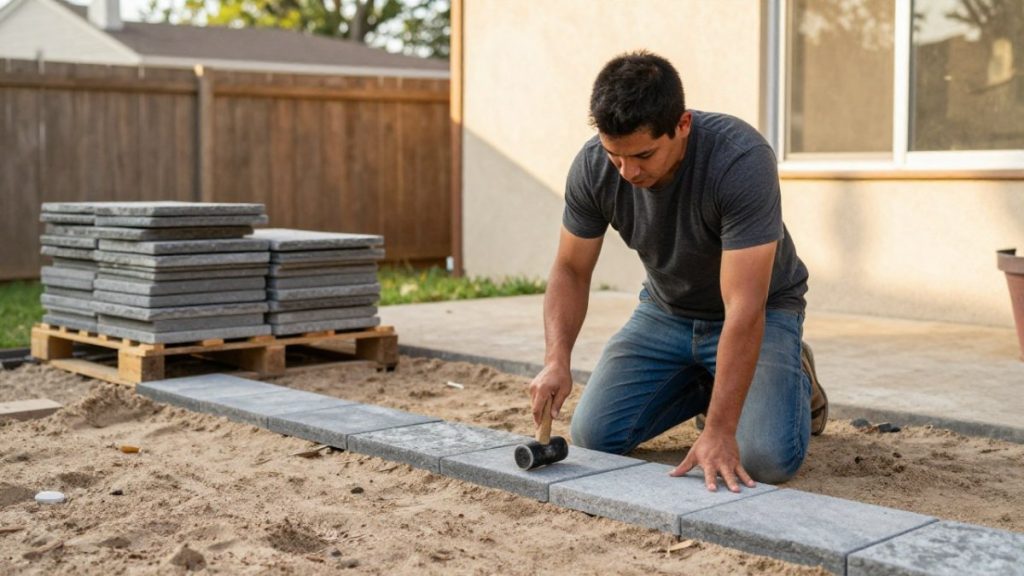
Last Updated: November 26, 2026
Quick Summary
The best modern patio paver patterns for backyards are simple layouts such as running bond, stack bond and large-format slabs, chosen to fit the yard’s shape, the home’s style and how the space will be used. Complex patterns often look cramped and cost more to lay, so restraint usually ages better.
- Running bond suits rectangular patios and long walkways and is the most common modern choice.
- Stack bond suits contemporary homes with strong vertical lines but shows any alignment error.
- Large-format slabs suit minimalist designs in larger yards and need a very level, well-compacted base.
- Use two or three materials or colors; five usually looks worse than two or three.
- Ask your installer how perimeter cuts will be handled before work begins.
Table of Contents
- Modern Patio Paver Patterns for Backyards Pictures and Visual Inspiration
- Simple Modern Patio Paver Patterns for Backyards
- Choosing a Paver Pattern by Backyard Size and Shape
- Matching Patterns to Your Home’s Architectural Style
- Paver Patio Ideas on a Budget
- Installation, Drainage, and Maintenance by Pattern
- Planning Your Backyard Patio With Deck-O-Art
- Frequently Asked Questions
Modern patio paver patterns for backyards work best when the pattern matches the yard’s shape, the home’s style and how the space will be used.
Running bond suits rectangular patios and long walkways. Stack bond suits contemporary homes with strong vertical lines. Large-format slabs suit minimalist designs in larger yards. Each looks deliberate, and simpler layouts are generally easier to install cleanly than intricate interlocking ones.
Many homeowners assume a complex pattern looks more modern, but the opposite is often true. Busy patterns can make a small backyard feel cramped and cost more to lay because every cut takes time. A restrained pattern with good proportions tends to age better.
What separates a pattern that works from one that doesn’t:
- Scale: the unit size should fit the size of the yard
- Direction: the lines should lead the eye toward a focal point, not away from it
- Restraint: two or three materials or colors usually look better than five
- Maintenance: tighter joints and fewer cuts mean less weeding and resetting over time
Modern patterns also reward careful planning. A pattern drawn on paper before excavation helps avoid a common regret: a layout that looked good in a photo but does not fit the yard’s actual dimensions.
Modern Patio Paver Patterns for Backyards Pictures and Visual Inspiration
Photos are the fastest way to decide which look you want, but most galleries show finished patios without naming the layout. Learn the five modern layouts below, then use photos to judge scale, color and edge detail rather than guessing at the pattern.
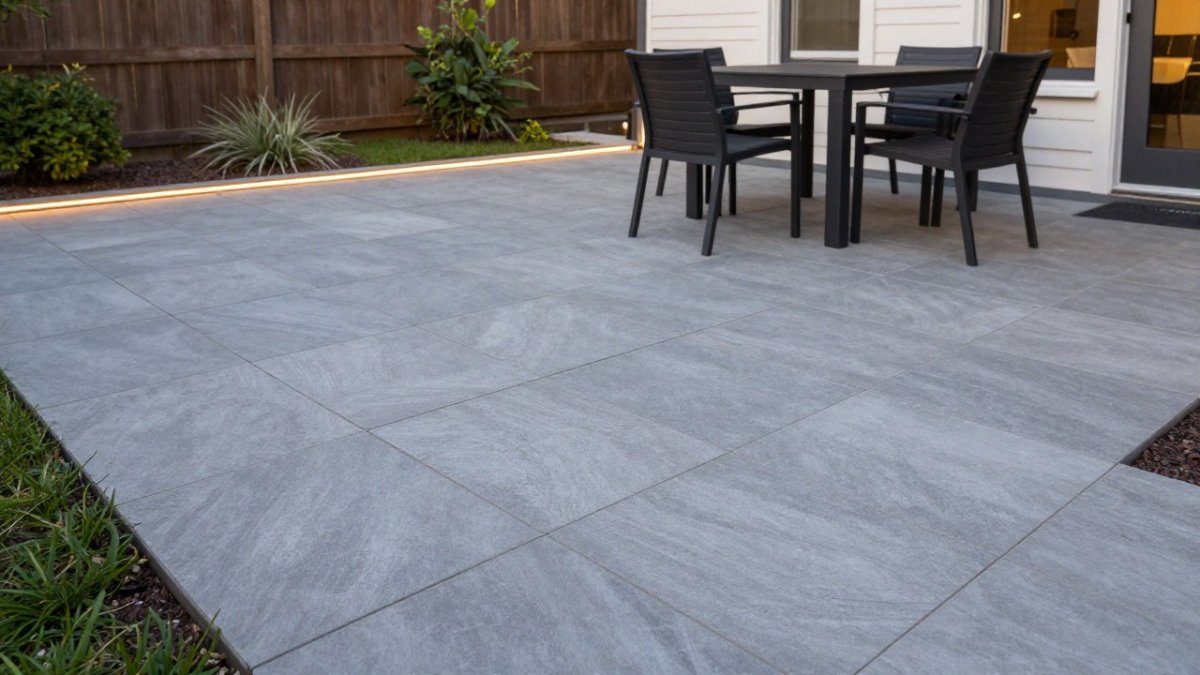
The five layouts worth knowing by name:
- Running bond: each row is offset by half a unit, like brickwork. It reads as calm and horizontal and is the most common modern choice for rectangular patios and walkways.
- Stack bond: every joint aligns directly over the one below, creating a sharp grid. It looks most contemporary on square or strongly rectilinear patios and demands precise setting.
- Herringbone: rectangular units meet at 90-degree angles in a zigzag. It is visually busy and best reserved for walkways, borders, or small accent areas rather than a whole backyard.
- Basketweave: pairs of units alternate horizontal and vertical, producing a woven block effect. It suits traditional and transitional homes more than minimalist ones.
- Modular or ashlar: mixed unit sizes fit together in an irregular but repeating layout. It handles curved edges and irregular yards better than rigid grids because the varied sizes absorb cuts.
When you review photos, look past the color. Pay attention to the joint lines, the way the pattern meets the house and whether the edging is crisp. Pictures rarely show scale well, so compare any image against your own yard measurements.
Keep a collection of photos that match your home’s style, labeled with the layout name from the list above.
Simple Modern Patio Paver Patterns for Backyards
Simple patterns are the most reliable choice for a modern yard. They are easier to install, easier to maintain and less likely to look dated. Two approaches dominate: running bond and stack bond on standard units, and large-format slabs for a minimalist finish.
Simple modern patio paver patterns can also make small installation imperfections less noticeable than complex layouts.
Running Bond and Stack Bond
Running bond staggers each row by half a unit, like brickwork, and looks clean on rectangular patios and walkways. Stack bond lines every joint directly over the one below, creating a sharp, contemporary grid. Stack bond shows any alignment error, so it demands precise setting but rewards you with a very crisp look.
Running bond is often a practical choice for many homeowners. Stack bond works best where the lines of the house are strongly vertical or the patio edges are perfectly square.
Large-Format Slabs for Minimalist Designs
Large-format slabs use few, big units to create a quiet, minimalist surface. Fewer joints mean less visual clutter and less weeding over time. The trade-off: large slabs require a very level, well-compacted base, because any settling shows immediately, and heavy units are harder to move and cut.
Large-format slabs generally suit yards with room to spare. In a small yard, they can make the space feel smaller than it is if the color contrast with the surrounding landscaping is too strong.
Choosing a Paver Pattern by Backyard Size and Shape
Yard size and shape should guide the pattern more than trends do. A pattern that looks sharp in a 600-square-foot yard can overwhelm a 200-square-foot courtyard.
Here is a practical starting point by yard type:
- Small or narrow yards (roughly under 300 square feet): Running bond in a light or mid-tone paver, with the long joint line running parallel to the house. Avoid large contrasting borders that cut the space visually. Herringbone is usually a poor fit here because the zigzag adds visual noise in a tight space and produces more perimeter cuts.
- Medium rectangular yards (roughly 300 to 600 square feet): Running bond or stack bond, with one accent border in a complementary color. The border frames the space without crowding it. Stack bond works best when the patio edges are perfectly square, because any out-of-square corner shows in the grid.
- Large yards (roughly 600 square feet and up): Large-format slabs or a combination of slabs and a smaller unit paver for transitions between zones such as a dining area and a walkway. Large slabs need a very level, well-compacted base because any settling shows immediately across the wide surface.
- Irregular or curved yards: Use a modular or ashlar pattern with mixed unit sizes, or choose a curved walkway that follows the shape rather than fighting it with straight rows. Rigid stack bond and large-format slabs are the hardest to fit to curves and generate the most cut waste.
Pattern direction matters too. Running the main joint lines toward the longest view can make a space feel deeper; running them across a narrow yard can make it feel wider.
Installation complexity generally tracks the pattern. Running bond and stack bond produce few cuts on a rectangular patio, while herringbone and basketweave require more cutting at edges and around obstacles.
Watch out: Mismatched cut edges are the most common visible flaw in a patterned patio. Ask your installer how they plan to handle perimeter cuts before work begins, because a clean pattern can look untidy if every edge is cut at a different angle.
The table below matches common yard types to a suitable pattern, using the guidance in this section.
| Yard type | Suggested pattern | Key consideration |
|---|---|---|
| Small or narrow (under 300 sq ft) | Running bond, light or mid-tone | Avoid large contrasting borders |
| Medium rectangular (300-600 sq ft) | Running bond or stack bond | Add one accent border |
| Large (600 sq ft and up) | Large-format slabs with smaller unit transitions | Needs a level, well-compacted base |
| Irregular or curved | Modular or ashlar pattern | Absorbs curves with less cut waste |
Matching Patterns to Your Home’s Architectural Style
The architecture of the house should inform the patio. Contemporary homes with flat roofs and large glass walls suit stack bond and large-format slabs. Traditional brick homes usually look best with running bond, which echoes the brickwork. Craftsman and ranch styles often pair well with a slightly warmer tone and a simple running bond that feels grounded rather than sharp.
Match the paver’s color to the home’s main material. A gray paver can look cold against warm brick, while a buff or warm-toned unit can soften the transition. When the house and patio colors clash, the whole outdoor space looks unresolved, even when each element is well built.
Paver Patio Ideas on a Budget
A modern look does not require the most expensive material. A simpler layout is one way homeowners can keep total project costs in mind, since complex patterns generally involve more labor and cutting.
Other budget choices include limiting the number of colors to two, using a single accent border rather than a full-surface design and phasing the project so a smaller patio is built first and expanded later. Pricing depends on the size of the area, the base preparation required, the material chosen and the access to the site. For current pricing or a quote, contact Deck-O-Art through the website. Keeping the layout compact and the palette restrained can make a phased patio feel cohesive, while custom patio design helps small yards use every available inch effectively.
Installation, Drainage, and Maintenance by Pattern
Each pattern has different installation and maintenance needs. If your existing pavers have already shifted, learn how to fix uneven patio pavers in McKinney.
Drainage is critical for every pattern. For more detail, see how to plan patio drainage before construction starts.
For a more detailed look at planning drainage before construction starts, see 7 Stamped Concrete Durability Facts for Texas Homeowners and 5 Low Maintenance Patio Surfaces for North Texas Yards.
Maintenance differs by pattern. Running bond and stack bond need periodic weeding in the joints and occasional resanding. Large-format slabs need less joint maintenance but more attention to surface cleaning, since their smooth finish shows staining more clearly.
Watch out: Installing a pattern over a poorly compacted base is the most expensive mistake in this category. The surface may look fine for a season, then settle unevenly once the base shifts.
Planning Your Backyard Patio With Deck-O-Art
A good patio starts with a conversation about how you will use the space.
Bring a few photos, a rough sketch of the yard and a list of how you want to use the patio. Note whether you plan to host, cook outdoors or simply need a quiet place to sit. Those answers shape the pattern, the size and the placement of any seating or kitchen area.
Deck-O-Art is a BBB-accredited company, fully insured, and has been in business since 1998. Deck-O-Art’s workforce is mostly in-house, and the company aims to keep the process clearly explained on every project.
To start planning your modern patio, contact Deck-O-Art for a consultation and site survey.
Frequently Asked Questions
What is the most popular paver pattern?
Running bond and herringbone are among the most widely used paver patterns because they are versatile and suit both traditional and contemporary yards. Running bond lays rows offset by half a paver, creating clean lines that work well with rectangular modern pavers. Herringbone adds visual movement and interlocks strongly, which helps it hold up under furniture and foot traffic. The best choice depends on your yard shape, the paver size you select, and how formal you want the finished look to feel.
Which paver patterns make a small patio look larger?
Patterns with long, linear joints tend to make a small patio feel more open. Running bond laid with the long edge parallel to the house, or large-format slabs with narrow joints, reduce visual clutter and carry the eye across the space. Avoid busy mixed-size layouts in tight areas, since they break the surface into small pieces. Matching the pattern direction to the longest sightline of the yard usually produces the best result.
Are large-format pavers a good choice for a modern patio?
Large-format pavers suit modern patios because they create a minimalist, continuous surface with fewer joints. They work especially well in yards with level, well-prepared subgrades, since larger units are less forgiving of settling. Installation typically requires more precise base work and sometimes specialized equipment for handling heavy slabs. Discuss site conditions, drainage, and expected use with a contractor before committing to a large-format layout.
How much should a 20×20 paver patio cost?
Pricing depends on paver material, pattern complexity, base preparation, drainage needs, access to the site, and current material and labor rates, so no single figure applies to every project. A simple layout may cost less than an intricate herringbone or border design with multiple paver sizes. For current pricing on a 20×20 patio, check Deck-O-Art’s website or contact the company for a quote.
