
Last Updated: November 28, 2026
Quick Summary
The cost to install pool deck drains depends on the drain type, the length of the run, site conditions, and whether the deck is new or existing, so no two yards price out the same. A current price comes from a site survey and quote, because slope, discharge point, and deck material all move the number.
- A retrofit costs more than a new build because the deck must be cut open and the surface restored.
- A transparent per-foot quote should itemize channel and grate, demolition, excavation, concrete restoration, pipe, and testing.
- Pipe and trenching are priced per foot of pipe run, not per foot of channel.
- Repair suits a cracked grate, clogged channel, separated pipe, or a drain that settled and no longer catches water.
- Plan the discharge point before the channel, since a drain emptying into a low corner just moves the problem.
Table of Contents
- How much does it cost to install pool deck drains?
- What drives pool deck drain installation cost per linear foot
- Using a pool deck drain installation cost calculator
- The cost to add a drain to an existing pool deck
- Pool deck drain repair cost versus full replacement
- Where pool deck drains drain to and why discharge planning matters
- Getting a pool deck drainage quote from Deck-O-Art
- Frequently Asked Questions
How much does it cost to install pool deck drains?
The cost to install pool deck drains depends on the drain type, the length of the run, site conditions, and whether the deck is new or existing. Most pool deck drainage projects fall into a broad range, and the honest answer is that no two yards price out the same.
Here is the short version: a short channel drain along one edge of a small deck costs far less than a full perimeter system tied into an existing yard drain. Labor and materials scale with linear feet, and retrofits cost more than new builds because the deck has to be cut open.
Below, we break down what actually moves the price, how to estimate your own project, and where homeowners get surprised. The goal is simple: you should walk into any quote conversation knowing which line items to ask about.
What drives pool deck drain installation cost per linear foot
Per-foot pricing is one way to compare pool deck drain quotes, but only if you know what the number includes. Here is the itemized way to read a per-foot price, and the factors that push it up or down.
The per-foot range, stated plainly. Pricing depends on drain type, deck material, site conditions, and scope, so no per-foot figure can be stated here. For current pricing or a quote for your deck, visit the Deck-O-Art website or contact the company directly.
What the per-foot price should itemize. A transparent quote breaks the run into these line items, each priced per foot or as a lump sum:
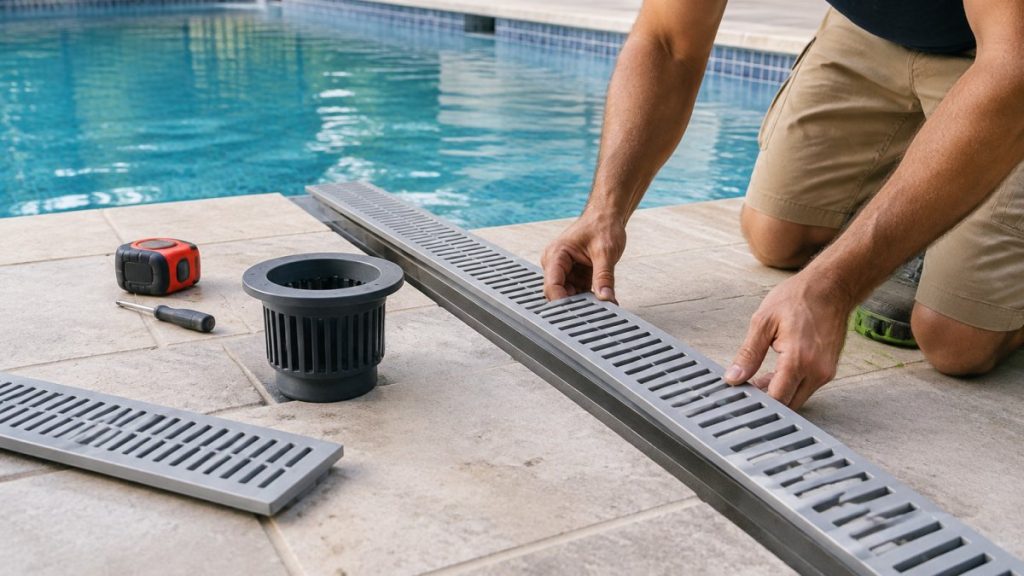
- Channel and grate material, the precast or formed channel body plus the grate. This is the single largest material line and the one that varies most by drain type.
- Demolition and saw-cutting, cutting a clean channel into finished concrete, including blade wear and the labor to keep the cut straight. Stamped concrete, pavers, and decks with unpredictable rebar take longer and cost more per foot.
- Excavation and spoil removal, digging the trench beneath the channel and hauling the spoil off site. Disposal is a real cost that cheap quotes often omit.
- Concrete work and restoration, grouting the channel in place, patching around it, and restoring the surface to match. On a retrofit, this is where the per-foot price climbs fastest.
- Pipe, fittings, and trenching to the discharge point, priced per foot of pipe run, not per foot of channel. A discharge point 40 feet across the yard adds pipe and trenching that a channel-only per-foot number never captures.
- Testing and commissioning, a water test to confirm slope and flow before the crew leaves.
Watch out: a per-foot price that does not state whether pipe, excavation, disposal, and surface restoration are included is not comparable to one that does.
New build versus retrofit per foot. Installing a channel drain during new deck construction avoids saw-cutting and the restoration work a retrofit requires. A retrofit adds demolition, careful cutting around existing finishes, and surface matching on top of the same channel and pipe cost.
A transparent per-foot quote should itemize these line items, each of which moves the final number.
| Line item | What it covers | What moves the cost |
|---|---|---|
| Channel and grate material | Precast or formed channel body plus grate | Largest material line; varies most by drain type |
| Demolition and saw-cutting | Cutting a clean channel into finished concrete | Stamped concrete, pavers, unpredictable rebar take longer |
| Excavation and spoil removal | Digging the trench and hauling spoil off site | Disposal is a real cost cheap quotes omit |
| Concrete work and restoration | Grouting channel, patching, matching surface | Climbs fastest on a retrofit |
| Pipe, fittings, trenching to discharge | Pipe run to the discharge point | Priced per foot of pipe, not channel |
| Testing and commissioning | Water test to confirm slope and flow | Done before the crew leaves |
Using a pool deck drain installation cost calculator
A pool deck drain installation cost calculator is a budgeting tool, not a quote. Here is how to get real value from one.
The four inputs that actually matter. Most calculators ask for total linear feet of drain, drain type, deck material, and discharge distance. Those four drive the bulk of the price. But a pool-deck-specific calculator should also ask for two things generic tools miss: whether the deck is new or existing, and how far the discharge point sits from the drain run. A retrofit adds demolition and restoration; a long discharge run adds pipe and trenching. If a calculator does not ask those, its output is a channel-only number, not a project number.
A worked example. Take a 40-foot run along one edge of an existing concrete deck, standard channel with a plastic grate, discharging to a yard drain 15 feet away. Because the yard drain can add its own excavation and connection work to the total, Natures Companion Landscaping is a useful next stop when estimating the catch basin portion of the project.
What the calculator cannot see. This is the part that matters most. A calculator cannot see a buried sprinkler line, a deck poured too flat to drain, a discharge point that sits on clay soil, or rebar in unpredictable places. Each of those turns a clean per-foot estimate into a change order.
How to use the output. Build a range, add a contingency for the unknowns above, then get a written quote from a contractor who has walked the site.
Watch out: a calculator that returns a single number with no assumptions stated is worse than no calculator at all. Look for one that shows its inputs and its per-foot assumptions, so you can adjust them to your deck instead of trusting a black box.
The cost to add a drain to an existing pool deck
Adding a drain to an existing pool deck costs more than installing one during a new build, and the reason is simple: the deck is already there.
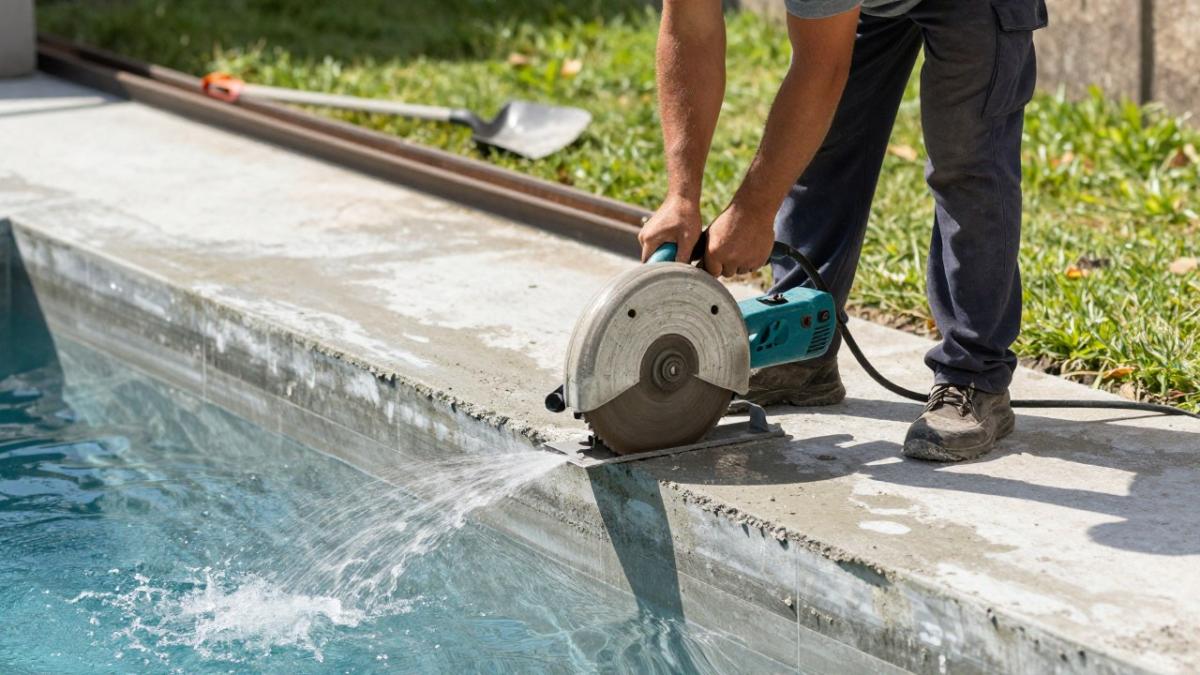
A retrofit means cutting a channel into finished concrete or lifting pavers, excavating beneath the deck, running pipe to a discharge point, and then restoring the surface so it matches. That restoration step is where retrofits get expensive.
A retrofit can preserve a deck that is structurally sound. If your deck is structurally sound and only the drainage is failing, cutting in a drain preserves the surface you already paid for.
Watch out: a contractor who quotes a retrofit without inspecting the deck’s slope and thickness is guessing. Ask what happens if the saw hits rebar or a buried line, and get that contingency in writing.
Pool deck drain repair cost versus full replacement
Repair is most appropriate when the drain system itself is the problem. If the deck around it is failing, repair alone may not solve the issue.
Repair makes sense when: the grate is cracked or missing, the channel is clogged with debris, a section of pipe has separated, or the drain has settled and no longer catches water. These are targeted fixes.
Replacement makes sense when: the channel is crushed, the pipe run is collapsed, the deck has settled so badly that the drain can no longer work, or the original system was undersized for the runoff it now handles.
A common mistake is repairing a drain that was installed at the wrong slope in the first place. Why pool decks crack and settle is worth understanding before you spend on repairs, because a cracked or heaved deck often signals the drainage was wrong from day one. If water still pools after a repair, the problem was never the drain component. It was the design.
Where pool deck drains drain to and why discharge planning matters
Where the water goes matters as much as how it gets there. A pool deck drain that empties onto the same patio, or into a low corner of the yard, just moves the problem.
Discharge options include tying into an existing yard drain, daylighting to a graded swale, routing to a dry well, or connecting to a storm system where local rules allow. Each has a cost and a limit. A dry well only works if the soil drains. A swale only works if the yard has somewhere to send the water.
This is where discharge planning earns its keep. If your yard holds water, drainage solutions for clay soil explains why the discharge point needs as much thought as the drain itself. Homeowners dealing with standing water across the whole yard should read how to fix standing water in a backyard before committing to a deck-only fix.
The takeaway: plan the exit before you plan the channel.
Getting a pool deck drainage quote from Deck-O-Art
A good quote starts with a site survey, not a phone call. Deck-O-Art has been in business since 1998, and a personalized consultation and site survey are part of the process.
Here is what to expect from a quote conversation:
- A measured drain run, not a guess, so per-foot pricing is real
- A stated discharge plan, so you know where the water ends up
- A clear scope, including excavation, disposal, and surface restoration
- A written contingency, in case the saw finds something unexpected
We are BBB-accredited and fully insured, and our workforce is mostly in-house.
If you are planning drainage before a new deck or patio goes in, our guide on planning patio drainage before construction covers the sequence. If your yard already ponds, the complete guide to fixing standing water goes deeper. And if your discharge point sits on heavy clay, see our clay soil drainage solutions.
You can also see finished pool deck and drainage work in our gallery before you call.
Pool deck drainage is one of those jobs where the cheapest quote often costs the most later. If your deck holds water after every rain, or you are planning a renovation and want the drainage designed in from the start, Deck-O-Art can survey the site, plan the discharge, and install a system built to last.
Frequently Asked Questions
Are pool deck drains necessary?
They are not required by every code, but they solve a real problem. Without a channel or trench drain, surface water from rain and splash-out pools on the deck, seeps toward the pool shell, and can undermine pavers or cause standing water. If your deck slopes back toward the house or you see puddles hours after rain, a drain is worth the spend. A site survey will confirm whether your existing slope already handles runoff.
Can you add a drain to an existing pool deck?
Yes. A retrofit means saw-cutting a channel into the existing slab, setting the drain body, tying it into a discharge point, and patching the cut. It involves cutting, dust control, and patching, but it avoids a full deck tear-out. The main limits are slab thickness, rebar placement, and whether a gravity line can reach a legal discharge point.
Where do pool deck drains drain to?
Most residential systems discharge to a graded pop-up emitter in the yard, a dry well, or a storm sewer where local rules allow it. The discharge point drives a large share of the cost, since a long pipe run or a lift pump adds labor and materials. Never tie a deck drain into the pool’s circulation line; it will overload the filter and is not designed for surface runoff.
Do pool deck drains need to connect to a drain line?
A channel drain needs somewhere for the water to go, so yes, it connects to a drain line in almost every case. Short runs can empty to a nearby emitter or splash block, but longer runs need a properly sloped pipe with cleanouts. If gravity cannot carry the water to a discharge point, a sump and pump setup is the alternative, and that adds cost to the project.
