
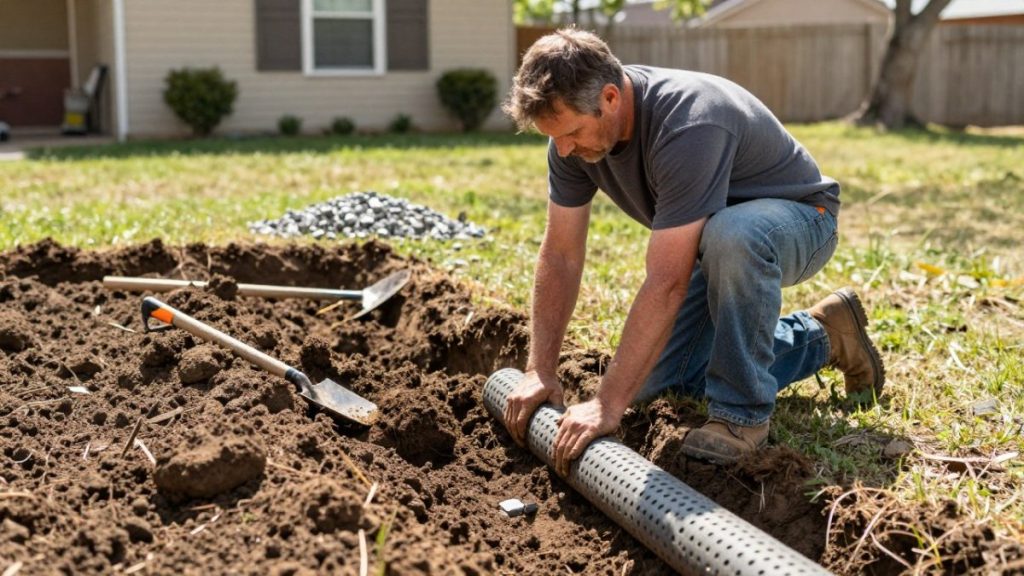
Last Updated: November 10, 2026
Quick Summary
Effective drainage solutions for clay soil yards combine three approaches: moving water across the surface with grading, swales, and downspout control; improving soil structure with core aeration and compost; and collecting subsurface seepage with a properly sloped French drain that has a legal outlet. Diagnose the water’s source first, because runoff, compaction, and a high water table each need a different fix.
- Walk the yard during rain to trace water and separate runoff, compaction, high water table, and blocked outlet causes.
- A French drain trench typically runs 12 to 18 inches wide and 18 to 24 inches deep with about 1 inch of drop per 8 feet.
- Use washed angular 3/4-inch gravel and non-woven geotextile fabric, never pea gravel or crusher run with fines.
- Core aerate in fall or spring, double aerating in different directions, then topdress with compost to build soil structure.
- Leave French drain trenching, stormwater tie-ins, and work near pools or decks to professionals.
Table of Contents
- Why Clay Soil Drains Poorly and Causes Waterlogging
- Diagnosing Yard Drainage Problems: Source, Slope, and Water Direction
- Surface Water Drainage in Clay Soil: Grading, Swales, and Downspout Control
- French Drain for Clay Soil: Construction, Gravel, and Outlet Design
- How to Improve Drainage in a Clay Soil Lawn with Aeration and Compost
- DIY Drainage Solutions for Clay Soil Yards: What You Can Do and What to Leave to Pros
- Choosing and Verifying a Drainage Solution That Works
- Schedule a Drainage Site Survey with Deck-O-Art
- Frequently Asked Questions
Why Clay Soil Drains Poorly and Causes Waterlogging
Clay soil is a dense, fine-grained soil with tiny pore spaces, and those tiny pores are the reason water sits on your lawn instead of soaking in. Heavy clay holds water tightly, drains slowly, and turns rock-hard when dry. The result is the familiar pattern: a downpour, then puddles that linger for days.
The mechanics matter because they dictate the fix. Clay particles pack tightly, so the natural infiltration rate is low. Compaction from foot traffic, construction equipment, or a house built decades ago makes it worse. When the soil is saturated, the water table rises near the surface and there’s simply nowhere for new rainfall to go.
That leaves you with three real options: move water across the surface, improve the soil so it accepts more, or collect it and carry it to an outlet. Most good drainage solutions for clay soil yards combine all three.
Diagnosing Yard Drainage Problems: Source, Slope, and Water Direction
Diagnosis starts with watching where water goes during a storm, not after it. For a deeper walkthrough of diagnosing and solving waterlogging, see our complete guide.
Work through these checks in order. Stop at the first one that matches, because fixing a downstream symptom before the upstream cause wastes money.
Step 1, Is the water arriving from somewhere else? Look up-slope.
Step 2, Does the water pond in the same spot every time, even after light rain? That pattern points to a low point or compacted soil.
Step 4, Is there a legal outlet, and is it actually working? Trace any existing drain, downspout line, or swale to where it ends.
Step 5, Map the low points and slope direction. A laser level or a string line with a line level is enough for a yard. Note where the ground falls and where it flattens.
A common pattern is a homeowner who installs a French drain to fix a puddle that is actually fed by a neighbor’s downspout.
Watch out: if you cannot find an outlet or the water appears without rain, stop and get a site assessment before digging.
Surface Water Drainage in Clay Soil: Grading, Swales, and Downspout Control
Surface water drainage in clay soil is mostly about positive drainage: shaping the ground so water runs away from the house by design, not by luck. The standard target is a slope that carries runoff away from the foundation and toward a safe discharge point.
Three tools do this work:
- Regrading: reshaping the soil so the surface falls away from the structure.
- Swales: shallow, vegetated channels that guide water along a controlled path.
- Downspout control: extending downspouts so roof runoff lands well away from the foundation, or tying them into a buried line.
Grading is where a lot of patios and pavers fail. Settled or uneven pavers often signal that water has been moving under the surface for years. If that sounds familiar, the process for fixing uneven patio pavers shows how grading problems get corrected rather than patched.
French Drain for Clay Soil: Construction, Gravel, and Outlet Design
A French drain for clay soil is a gravel-filled trench containing a perforated pipe that collects subsurface water and carries it to an outlet.
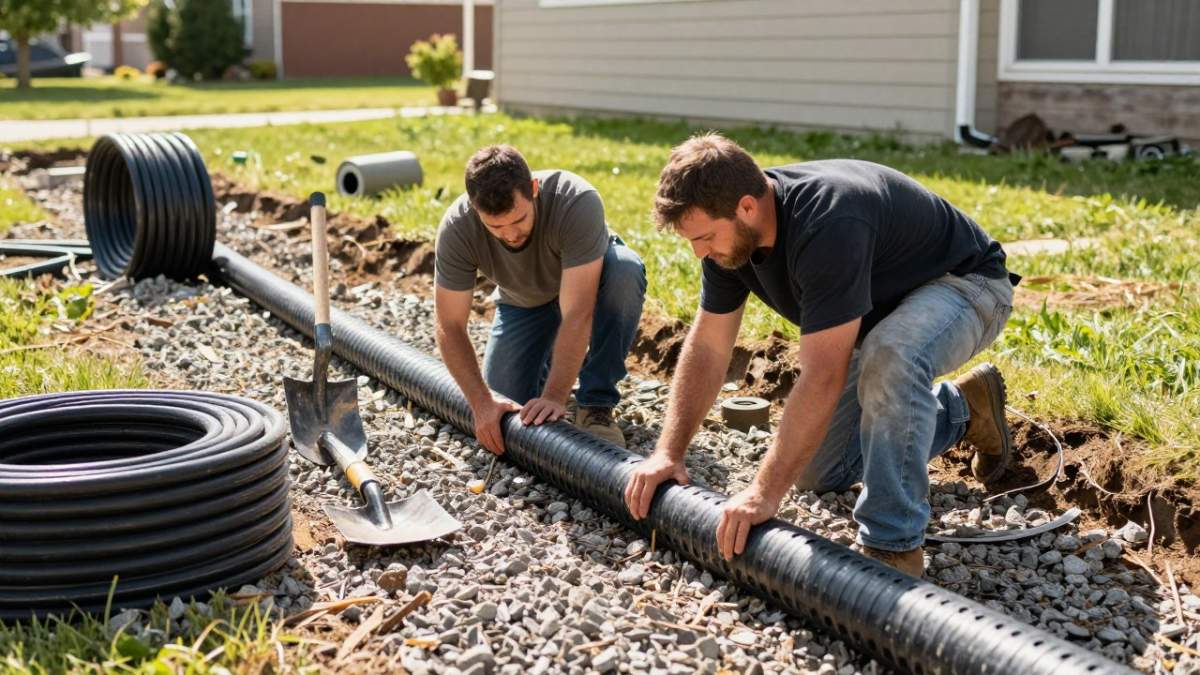
The specifications that decide whether it lasts. Exact numbers depend on site conditions, soil, and the volume of water, so treat these as planning ranges and confirm against a site assessment:
- Slope: the trench bottom needs a continuous fall toward the outlet. A common target is about 1 inch of drop per 8 feet of run (roughly 1 percent), and flatter than that invites silting. Never allow a back-pitch or a flat section.
- Depth and width: a typical residential trench is 12 to 18 inches wide and 18 to 24 inches deep, deep enough to intercept the seepage zone but not so deep that you hit a clay pan and create a bathtub. In clay, shallower and wider often outperforms deep and narrow.
- Pipe: 4-inch perforated corrugated or rigid PVC is the common residential size, with perforations facing down so water enters from below rather than collecting silt from the surface.
- Gravel: washed, angular drainage gravel in the 3/4-inch range, not pea gravel and not crusher run with fines. Fines are what clog the system in clay.
- Filter fabric: a non-woven geotextile wrapped over the gravel and around the pipe keeps clay particles out of the gravel bed. In heavy clay, some practitioners also line the trench bottom and sides, or use a gravel envelope, because clay migration is the main failure mode.
- Outlet: the pipe must daylight at a point lower than the trench, or discharge into a dry well, storm connection, or approved outfall. The outlet must be below the inlet or the drain holds water.
Why clay changes the design. In sandy soil, water enters a French drain from all sides quickly. In clay, infiltration is slow, so the trench captures a narrow band of seepage and the surrounding soil stays wet.
The outlet is non-negotiable. A pipe that ends in a flat lawn, a buried line with no daylight, or a trench with no fall becomes a bathtub that fills and stays full.
Watch out: a French drain dug with no fall and no outlet is the most common failure in clay yards. The trench fills, the puddle returns, and the money is gone.
How to Improve Drainage in a Clay Soil Lawn with Aeration and Compost
How to improve drainage in a clay soil lawn comes down to changing soil structure, not just moving water. Core aeration pulls small plugs of soil out and opens channels for air and water. Double core aeration, going over the lawn twice in different directions, opens more.
Then add organic matter. Compost worked into the surface, or applied as a thin topdressing after aeration, feeds the soil biology that builds crumb structure over time. Sand and gypsum get recommended often; sand alone can make clay harder if mixed poorly, and gypsum only helps certain clay types. Compost is the safer bet.
Timing matters. Aerate in fall or spring when the lawn is actively growing, water lightly afterward, and expect improvement over seasons, not days. This is the slow fix, but it’s the one that reduces how often the yard floods at all.
DIY Drainage Solutions for Clay Soil Yards: What You Can Do and What to Leave to Pros
DIY drainage solutions for clay soil yards are realistic for the small stuff: extending downspouts, raking and regrading a low spot, aerating, topdressing with compost, and clearing debris from existing channels. These are low-risk, low-cost, and often enough for mild cases.
Where it gets risky: trenching near utilities, cutting into a patio or deck, tying into stormwater lines, and any work near a pool shell or foundation. Permits and utility locates apply in many cases, and safe discharge has to go somewhere legal. If a project requires excavation or changes how water leaves the property, that’s the point to bring in a professional.
| Task | DIY or Pro | Why |
|---|---|---|
| Extend downspouts | DIY | Low risk, no digging |
| Aerate and topdress | DIY | Routine lawn care |
| Regrade a small low spot | DIY | Hand tools only |
| Dig a French drain trench | Pro | Slope, outlet, utilities |
| Tie into stormwater line | Pro | Permits and safe discharge |
| Drainage near pool or deck | Pro | Structural risk |
Choosing and Verifying a Drainage Solution That Works
Choosing a solution comes down to matching the fix to the symptom, slope, and yard layout. Standing water in the middle of a flat lawn points to soil improvement and a shallow swale. Water against the foundation points to grading and downspout control. Water over a patio or near a pool points to surface collection and a proper outlet.
Verification is the step most people skip. After the work, watch the yard through a heavy rain. Check that water reaches the outlet, that no new low spots form, and that the foundation and deck edges stay dry. A solution that works in a drizzle but fails in a storm hasn’t been tested.
If your drainage ties into a pool or spa area, our drainage solutions for pools and spas cover how those systems are designed and where water is safely discharged.
Schedule a Drainage Site Survey with Deck-O-Art
The most reliable way to fix a wet yard is to diagnose it on site, and that’s exactly what our site survey does. Deck-O-Art has handled outdoor transformations since 1998, is BBB-accredited and fully insured, and works with a mostly in-house crew. We start with a personalized consultation and site survey, then build a plan around your yard’s slope, soil, and layout.
If standing water around your patio, pool, or foundation has been a recurring problem, stop guessing at fixes. Contact us to schedule your drainage site survey and get a plan built for your property.
Clay soil doesn’t have to mean a flooded yard every spring. The right combination of grading, soil improvement, and a properly built drain with a real outlet solves most cases. Get started with Deck-O-Art and put a site survey behind your drainage plan, backed by our in-house crew, full insurance, and decades of local outdoor work.
Frequently Asked Questions
How can I improve the drainage of my yard if it has clay soil?
Start by diagnosing where water collects and which way the ground slopes. Then combine surface fixes with soil improvements: regrade low spots so water flows away from the foundation, extend downspouts at least 6 feet from the house, and run core aeration followed by compost topdressing to open up the clay. For persistent standing water, a French drain with a reliable outlet may be needed. A professional site survey confirms which combination fits your yard.
Does adding sand to clay soil improve drainage?
Usually not. Mixing sand into heavy clay can create a concrete-like layer that drains even worse, because the fine clay particles fill the gaps between sand grains. The safer route is organic matter: compost, aged manure, or leaf mold worked into the top few inches. Core aeration first, then compost, gradually builds soil structure so water infiltrates instead of pooling.
Do French drains work in clay soil?
They can, but only with the right design. Clay absorbs water slowly, so a French drain in clay soil must rely on a properly sloped trench, washed drainage gravel, perforated pipe wrapped in filter fabric, and a clear outlet that carries water to a safe discharge point. Without a working outlet, the trench fills and the drain fails. Expect slower performance than in sandy soil.
How do I tell whether my yard needs surface drainage or a subsurface drain?
Watch where water goes after heavy rain. If it sheets across the surface or ponds in shallow low spots near the house, surface grading, swales, and downspout extensions often solve it. If the ground stays soggy for days or water reappears after the surface dries, the problem is below grade and a subsurface drain such as a French drain is likely needed. Many yards need both.
Will fixing drainage around my pool or patio prevent future water damage?
Yes, when the fix directs water away from hardscapes and the foundation. Standing water around a pool deck or patio can undermine concrete, stain surfaces, and cause slip hazards. Regrading, channel drains, and correctly routed downspouts keep runoff moving.
