
Last Updated: October 30, 2026
Quick Summary
Choose a pool renovation contractor by verifying their license and insurance, interviewing them about renovation-specific experience, and comparing bids line by line. Confirm permits, payment schedules tied to completed milestones, and written workmanship warranties before signing. The right contractor brings renovation experience, not just new-build experience.
- Confirm the contractor’s license name matches the name on the contract before paying any deposit.
- Call the insurance carrier to verify general liability and workers’ comp policies are active.
- Compare bids line by line, since a cheaper bid that excludes drainage is incomplete.
- Structure payments to trail completed milestones and collect lien waivers at each draw.
- A plaster-only resurfacing typically leaves the pool unusable for one to two weeks.
Table of Contents
- Why the Right Pool Renovation Contractor Decides Your Project’s Outcome
- Signs You Need New Pool Plaster and Other Renovation Triggers
- How to Verify Pool Contractor Insurance and Licensing
- Questions to Ask Pool Renovation Companies Before You Hire
- Comparing Bids Apples to Apples: Materials, Labor, and Scope
- Your Pool Renovation Contract Checklist: Permits, Payments, and Warranties
- Red Flags, Change Orders, and Managing Project Disruption
- Booking Your Pool Renovation Consultation
- Frequently Asked Questions
Why the Right Pool Renovation Contractor Decides Your Project’s Outcome
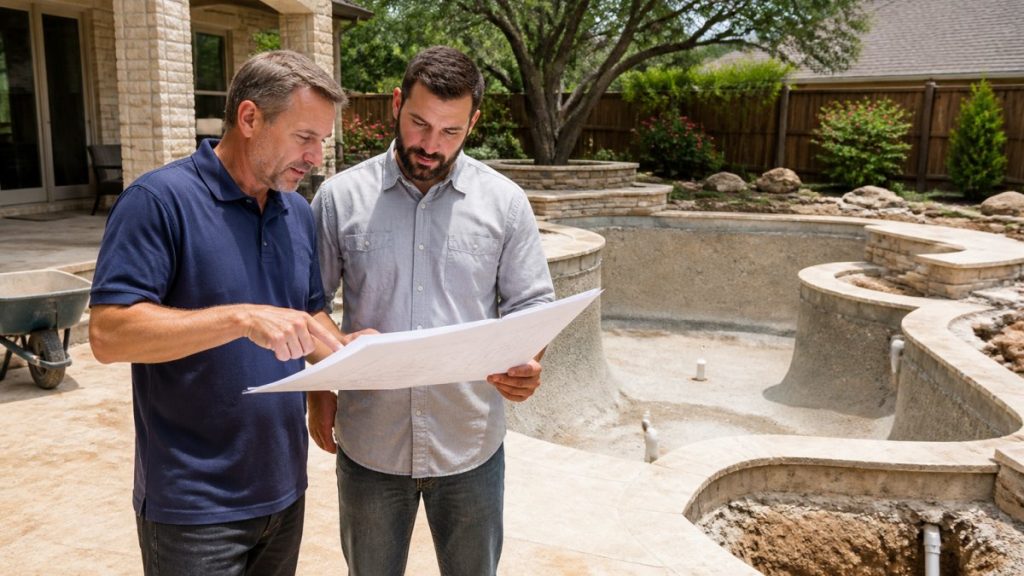
Choosing the wrong pool renovation contractor costs more than money. It costs a season of swimming, and sometimes the whole project has to be redone.
A pool renovation contractor is the licensed professional who removes and replaces pool finishes, tile, coping, and surrounding deck surfaces.
Below, we break down exactly how to screen, question, compare, and contract a renovation specialist so your project lands once and lasts.
Signs You Need New Pool Plaster and Other Renovation Triggers
Knowing when to renovate is half the hiring decision. Most homeowners start shopping after a visual failure, but the warning signs usually appear earlier.
The clearest triggers for a renovation:
- Chalky white residue that rubs off on skin and swimsuits
- Rough patches that snag feet or inflate chemical demand
- Cracks that return after patching
Drainage belongs on that list too. Water that pools around the deck after rain signals a grading or surface problem that a resurfacing job alone won’t solve. For a deeper breakdown of plaster failure, read our guide to the signs you need new pool plaster.
How to Verify Pool Contractor Insurance and Licensing
Verification is the step homeowners skip most often, and it is the one that protects you from the largest financial exposure. A contractor’s license and insurance are not paperwork formalities; they are the difference between a covered accident and a claim against your homeowner’s policy.
Run these checks before any deposit changes hands:
- License status. Confirm the contractor holds a current license for pool and spa work, and check the name on the license matches the name on the contract.
- General liability insurance. Ask for a certificate of insurance and call the carrier to confirm the policy is active. Liability coverage protects your property if a crew member damages the shell, plumbing, or deck.
- Workers’ compensation. If a worker is injured on your property and the company carries no workers’ comp, the claim can land on you.
- Business standing. Check registration with the state and look for accreditation with the Better Business Bureau.
Deck-O-Art has been fully insured and BBB-accredited since 1998. For a location-specific walkthrough of this process, see this guide to hiring pool contractors in McKinney TX.
Questions to Ask Pool Renovation Companies Before You Hire
The questions you ask during the contractor interview separate renovation specialists from generalists. Prepare them in advance and write down the answers; vague responses are themselves a signal.
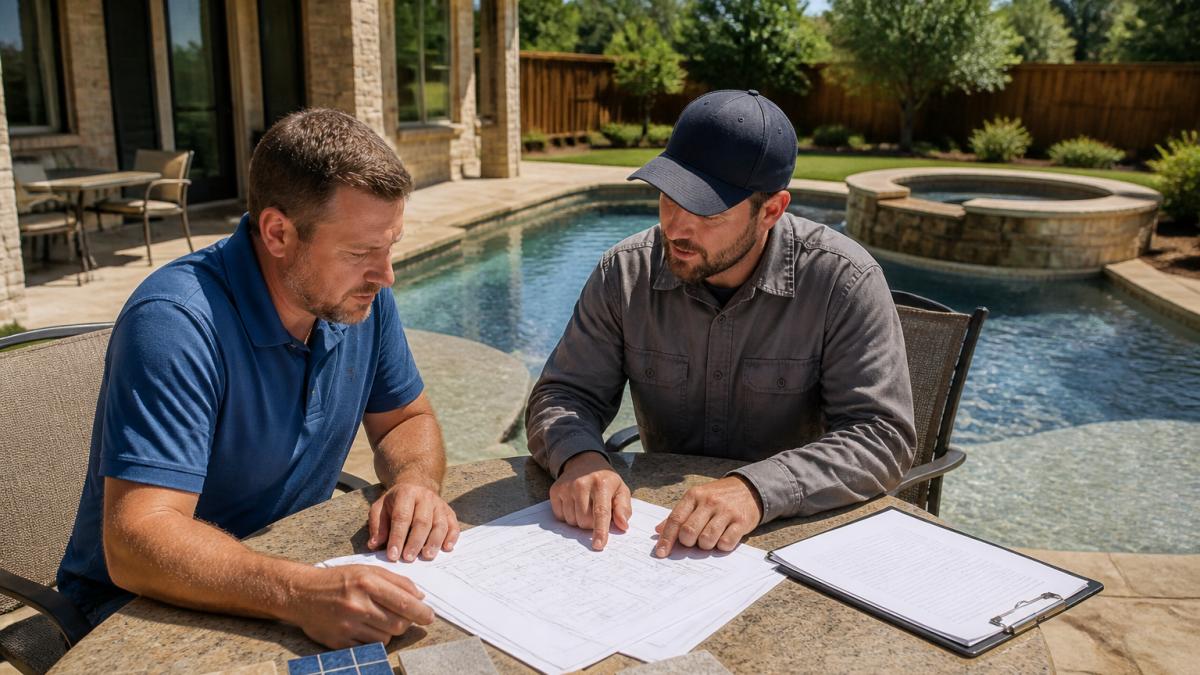
Ask these screening questions:
- How many renovations have you completed on pools similar in age and construction to mine?
- Will your own crew perform the work, or will you subcontract it?
- What does your written estimate include, and what does it exclude?
A common mistake is treating the interview as a formality after the price is agreed. This conversation can tell you as much about the finished result as the number at the bottom of the bid.
Comparing Bids Apples to Apples: Materials, Labor, and Scope
Three bids that look similar on price are rarely similar in substance. The only way to compare pool renovation quotes fairly is to normalize them line by line.
Build a comparison sheet with these rows:
| Line item | What to confirm |
|---|---|
| Surface prep | Full chip-out vs. skim coat |
| Finish material | Product name, brand, and application method |
| Tile and coping | Material type, quantity, replacement scope |
| Deck work | Resurfacing vs. full replacement |
| Drainage | Included, excluded, or priced separately |
| Labor | In-house crew vs. subcontractors |
| Permits and inspections | Who files and who pays |
| Timeline | Start date, duration, weather contingencies |
| Warranty | Workmanship and material terms |
| Payment schedule | Deposit, progress draws, final payment |
If one bid excludes drainage and another includes it, the cheaper number is not cheaper. It is incomplete. Push every contractor to state exclusions in writing.
Your Pool Renovation Contract Checklist: Permits, Payments, and Warranties
The contract is where a good renovation gets protected. A pool renovation contract checklist should cover permits, payment safeguards, and warranty terms before you sign.
Work through it in this order:
- Written contract naming the licensed entity, not a trade name
- Detailed scope of work matching the accepted bid
- Permit responsibility stated, with the contractor filing
What Renovation Work Actually Costs
Prices vary by region, pool size, and existing condition, so treat any single number as a starting point, not a quote. As a planning framework, most homeowners should expect the following relative cost tiers:
| Renovation type | Typical scope | Relative cost |
|---|---|---|
| Plaster resurfacing only | Chip-out, prep, new plaster | Lowest |
| Plaster plus waterline tile | Adds tile removal and reset | Moderate |
| Tile, coping, and plaster | Full shell refresh | Moderate to high |
| Full renovation with decking | Adds deck resurfacing or replacement | High |
| Renovation with equipment upgrade | Adds pump, filter, heater, or automation | Highest |
The biggest cost drivers are not the finish itself. They are access to the pool, the condition of the shell and plumbing once plaster comes off, the square footage of decking, and whether permits and inspections add fees and schedule time. Ask each bidder to break the price into labor, materials, demolition and disposal, permits, and contingency so you can see where the money goes.
Payment Safeguards That Protect Your Money
A front-loaded payment schedule is the most common way homeowners lose leverage. Structure payments so they trail completed work:
Ask for lien waivers from the contractor and major suppliers at each payment draw. A lien waiver is a written statement that a party has been paid and gives up the right to file a lien against your property. Without them, an unpaid supplier can cloud your title even after you have paid the contractor in full. Keep every waiver with the contract.
A fair contract pays for work already done, documents every change in writing, and leaves you holding a meaningful final payment until the pool is swimmable and the punch list is closed.
Permits, Inspections, and Warranty Terms
Confirm in writing who pulls the permit, who pays the fee, and who is on site for inspections. A licensed contractor is typically the party of record for permits, and a homeowner-pulled permit can shift liability onto you. For warranties, get two documents: the contractor’s workmanship warranty (duration, what voids it, who honors it if the company is sold) and the manufacturer’s material warranty for the finish, tile, and equipment.
Red Flags, Change Orders, and Managing Project Disruption
Renovation work disrupts a backyard. The question is whether the disruption is planned or chaotic. The same signals that predict schedule trouble also predict quality trouble.
Red flags worth walking away from:
-
A bid far below the others with no explanation of scope differences
-
Pressure to sign the same day or a discount that expires in 24 hours
-
No physical business address or no verifiable license number
-
No clear answer on who handles permits
-
A crew that cannot name the last three renovations they completed in your county
Change orders deserve their own attention. Hidden damage behind old plaster is common, so a legitimate change order should arrive in writing with a price and a schedule impact before work continues. Verbal approvals create disputes.
What Pool Downtime Actually Looks Like
Set expectations before demolition, not after. A typical plaster-only resurfacing leaves the pool unusable for roughly one to two weeks of work plus a fill and startup period; a full renovation that includes tile, coping, decking, and equipment can run several weeks longer. Weather, hidden damage, and inspection scheduling all move that window. Ask each bidder for a written sequence with these phases:
- Mobilization and protection, equipment placement, debris staging, and barriers around the pool area.
- Demolition and chip-out, the loudest, dustiest phase; ask how debris leaves the property and whether a dumpster sits on the driveway or the street.
- Structural and plumbing repairs, where hidden damage surfaces and change orders originate.
- Surface application, finish, tile, and coping, each with cure or set time before the next trade starts.
- Deck and drainage work, often the phase that collides with landscaping and irrigation.
- Fill, startup, and walkthrough, chemical balancing, equipment checks, and your punch list.
Access, Safety, and Daily Site Rules
Ask each contractor to put site rules in writing: what hours crews arrive and leave, where vehicles park, which gate or side yard is used for access, whether the homeowner must be present, and how the pool area is secured for children and pets. A mesh safety cover or temporary fencing during downtime is a reasonable request; a contractor who resists it is telling you something.
How Schedule Changes Should Be Documented
A verbal “we’ll be back Tuesday” is not a schedule. Ask for a written start date, a completion estimate, and a weather-delay clause in the contract. When a delay happens, the update should state the cause, the new date, and whether the change affects the payment schedule. Keep a simple log of dates, promises, and who said what; if the job goes sideways, that log is worth more than memory.
Photograph the pool, deck, and landscaping before mobilization. Date-stamped photos establish the baseline for any damage dispute and make the final walkthrough faster.
If a contractor asks for a large progress draw before demolition is complete, treat it as a payment-schedule red flag. Payments should trail completed milestones, not fund the next one.
Booking Your Pool Renovation Consultation
The final step is the one that turns research into a finished backyard. A consultation should include a site survey, a conversation about how you actually use the pool, and a written scope you can compare against other bids.
Before you book, confirm that the contractor services your neighborhood and ask how the consultation is conducted.
Deck-O-Art offers swimming pool and spa renovations, custom patio decking, and hardscaping, with a personalized consultation and site survey process. You can review the pool and spa renovation services we offer, learn more about our company and our history since 1998, or reach out through our contact page to schedule your consultation.
Frequently Asked Questions
What questions should I ask a pool renovation contractor?
Ask how long the company has been in business, whether the crew is in-house or subcontracted, how many renovation projects they complete per year, and what their process looks like from consultation to final inspection. Request a written scope with materials and labor broken out, confirm who handles permits, and ask what happens if the project runs past schedule. A contractor who answers these specifics clearly and in writing is usually the one who will stand behind the work.
How do I verify if a pool contractor is licensed and insured?
Ask for the contractor’s license number and check it against your state or local licensing database, then confirm the policy is current by requesting a certificate of insurance directly from the insurer. Look for general liability coverage and workers’ compensation. Call the insurer to confirm the policy is active and the coverage limits match what the contractor claims. A legitimate pool renovation contractor will hand over these documents without hesitation before you sign anything.
What are the red flags when hiring a pool renovation company?
Watch for large upfront deposits, no written contract, pressure to sign the same day, vague scopes that list lump sums without materials or labor, and crews that are entirely subcontracted with no named supervisor. A contractor who cannot produce a certificate of insurance, avoids questions about permits, or refuses to put warranty terms in writing is a risk. Also treat unusually low bids with suspicion, since they often lead to change orders once work starts.
Should I hire a general contractor or a specialized pool renovator?
For pool resurfacing, tile replacement, and deck renovation, a specialized pool renovation contractor usually delivers better results because the work involves specific materials and sequencing. A general contractor makes sense when the project is part of a larger home renovation and the pool is a small piece. Ask any candidate how much of their annual work is pool renovation specifically, and request past projects that match your scope.
How long does a typical pool renovation project take?
Timelines depend on scope: resurfacing and tile work typically take a few weeks, while full renovations with deck replacement, plumbing changes, or water features run longer. Weather, permit approvals, and material lead times all affect the schedule. Ask for a written timeline with milestones and a clear statement of what happens if the contractor falls behind. Confirm how many other projects the crew will be running at the same time.
What should be included in a pool renovation contract?
A solid contract names the exact materials and products, the project scope, start and completion dates, payment schedule tied to milestones, permit responsibility, change order procedures, and warranty terms for both workmanship and materials. It should also state who is responsible for cleanup and site protection. Read the warranty section closely, and confirm the payment schedule does not front-load most of the money before work begins.
Picking a renovation contractor comes down to verification, comparison, and contract discipline, and the homeowners who do all three avoid the expensive restart. If you want a team that has handled pool and deck renovations since 1998, is fully insured and BBB-accredited, and keeps the work largely in-house, Deck-O-Art is ready to survey your project. Get started with Deck-O-Art and turn your aging pool into a backyard you actually use.
