
Last Updated: November 8, 2026
Quick Summary
The long-term value of patio upgrades comes from daily use, not just resale. Prioritize structure before decoration: a properly graded, well-drained base, then shade, then durable decking, since these outlast decorative features and protect everything built above them.
- A properly graded, well-drained patio base is the single most important line item.
- Structural and shade upgrades outlast decorative ones over time.
- Compare surfaces by cost per year of use, not sticker price alone.
- Fix drainage and grading first, because nothing else lasts without it.
- Spend on structure before decoration to avoid paying twice later.
Table of Contents
- How Patio Upgrades Build Value Beyond Resale
- Which Patio Upgrades Add the Most Long-Term Value
- What Patio Paver Cost Really Reflects Over Time
- Patio Pavers vs. Concrete: A Lifecycle Comparison
- Patio Paver Maintenance That Protects Your Investment
- Patio Drainage Solutions That Extend a Patio’s Life
- Prioritizing Patio Upgrades on a Realistic Budget
- Planning Your Patio Upgrade With a Site Survey
- Frequently Asked Questions
How Patio Upgrades Build Value Beyond Resale
Most homeowners judge a patio by what it adds at closing. That math undersells it. The value of patio upgrades shows up every weekend, not just on the settlement sheet.
A patio is an outdoor room. It adds usable space without adding heated square footage. It also gives you a reason to stay home instead of spending money elsewhere.
At Deck-O-Art, we have built and renovated outdoor spaces around McKinney since 1998.
The Daily Use Value Homeowners Often Overlook
Think about a typical North Texas summer. A well-built patio with shade turns a bare backyard into the room your family uses most.
- Morning coffee outside instead of at the kitchen counter
- Kids doing homework under a covered pergola
- Friends gathered around a fire pit on a cool evening
None of that shows up in a listing. All of it pays you back weekly.
Which Patio Upgrades Add the Most Long-Term Value
Not every upgrade earns its keep equally. Ranked by how much use and durability they deliver per dollar, the following order is a common starting point:
- A properly graded, well-drained patio base. Boring, invisible, and the single most important line item. Skip it and everything above it fails early.
- Shade structures. A pergola or covered section can make the patio usable in hot months.
- Paver or stamped concrete decking. Durable surfaces suited to local conditions when properly installed.
- An outdoor kitchen or grill station. High use, but plan plumbing and gas carefully.
- A fire pit or outdoor fireplace. Extends the season into cooler months.
- Low-voltage lighting and seating. Small cost, big jump in evening usability.
The pattern is clear. Structural and shade upgrades outlast decorative ones.
FEMA guidance on proper site grading and drainage is a useful primer on why water management belongs at the top of any outdoor project list.
What Patio Paver Cost Really Reflects Over Time
Patio paver cost depends on a bundle of decisions: base depth, drainage, material choice, edge restraint, and labor.
Two patios can look identical on day one and behave very differently in year five. The cheaper one usually skipped something you cannot see.
What drives patio paver cost up or down:
- Base preparation. Deeper, compacted, properly graded base costs more upfront and prevents settling.
- Material selection. Concrete pavers, clay brick, and natural stone carry different price tags and lifespans.
- Drainage work. Slopes, channel drains, and tie-ins to existing storm flow add cost and add years.
Pricing depends on the scope of each project. For current prices or a quote, contact Deck-O-Art.
Patio Pavers vs. Concrete: A Lifecycle Comparison
The real question is not which surface costs less today. It is which one costs less over the years you plan to stay, and how much upkeep each demands along the way. A lifecycle view compares installed cost, routine maintenance, repair behavior, and replacement horizon rather than sticker price alone.
Upfront Cost, Repair, and Lifespan Compared
| Factor | Pavers | Poured Concrete |
|---|---|---|
| Upfront cost | Higher per square foot | Lower per square foot |
| Repair method | Lift and replace single units | Patch or replace a slab section |
| Crack behavior | Flexes at joints, spreads movement | Cracks can run across the slab |
| Lifespan with good base | Long, decades with upkeep | Moderate, varies with soil and joints |
| Surface refresh | Re-sand joints, clean, seal | Reseal or overlay |
| Drainage | Permeable joints help water pass | Needs slope and control joints |
| Routine upkeep | Joint sand refills, weed control, occasional sealing | Cleaning, crack sealing, resealing |
| Replacement horizon | Individual units can be swapped indefinitely | Full slab replacement is a larger event |
| Best for | Long-term owners, freeze-thaw and clay soils | Tight budgets, simple flat areas |
Pavers are generally easier to repair than a single slab, since a cracked or settled unit can be lifted and replaced. Concrete is one continuous surface, so a major failure can involve a larger section. That difference matters most in clay soils and freeze-thaw cycles, where movement is common and a single crack can widen into a trip hazard.
How to Compare Lifecycle Cost Without Guessing
One way to compare surfaces is a simple cost-per-year-of-use estimate rather than a single installed price. The mechanics are straightforward:
- Estimate total installed cost, including base preparation, drainage, edge restraint, and labor.
- Add expected routine maintenance over your planned ownership period, such as joint sand, sealing, cleaning, and minor repairs.
- Estimate the likely resale contribution at the end of that period, using conservative local buyer expectations rather than a guaranteed return.
- Divide the net cost by the number of years you expect to use the patio.
That last number, cost per year of enjoyment, is the figure that actually separates two surfaces that look identical on day one. A surface with a higher upfront price but lower annual upkeep and a longer replacement horizon can win on cost per year even when it loses on sticker price. The reverse is also true for a short ownership window.
Watch out: comparing bids that quote different base depths, drainage scope, or edge restraint is not a lifecycle comparison at all.
Stamped concrete overlays can refresh an existing slab as an alternative to a full rebuild, provided the base is sound.
If you want to compare the decking options we install side by side, see our pool and patio decking services and our concrete installation services.
Patio Paver Maintenance That Protects Your Investment
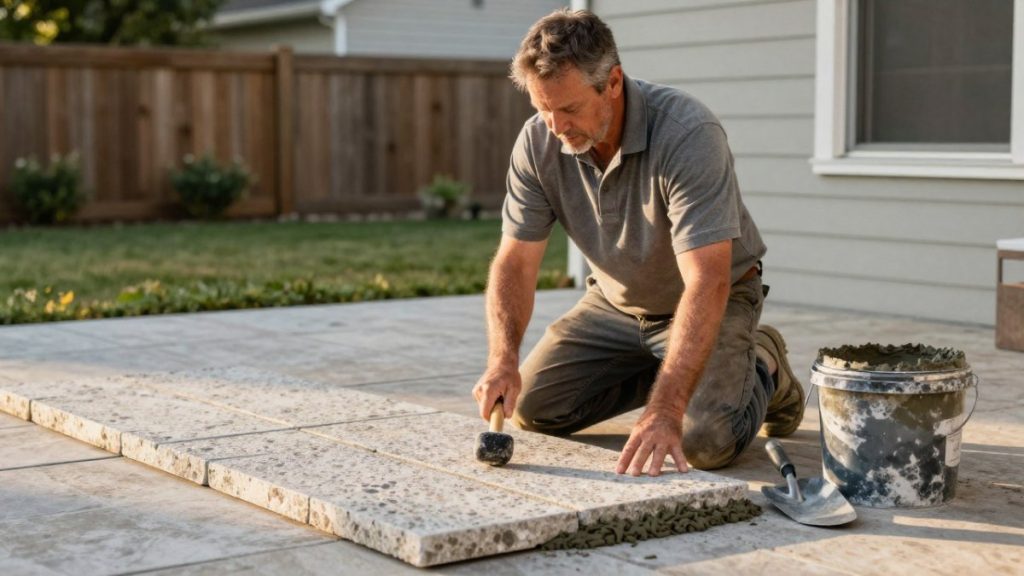
Patio paver maintenance is simple, and skipping it can shorten the life of a good installation.
- Sweep off debris and check for loose or rocking pavers
- Refill joint sand where it has washed out
- Pull weeds from joints before roots widen gaps
Watch out: power washing too aggressively strips joint sand and loosens the bedding. That is how a solid patio starts to wobble.
If you already have uneven pavers, our guide on how to fix uneven patio pavers walks through the causes and the fixes.
Patio Drainage Solutions That Extend a Patio’s Life
Patio drainage solutions decide whether your investment lasts or fails early. Water is the number one enemy of any hardscape, and North Texas clay soil does not absorb it quickly.
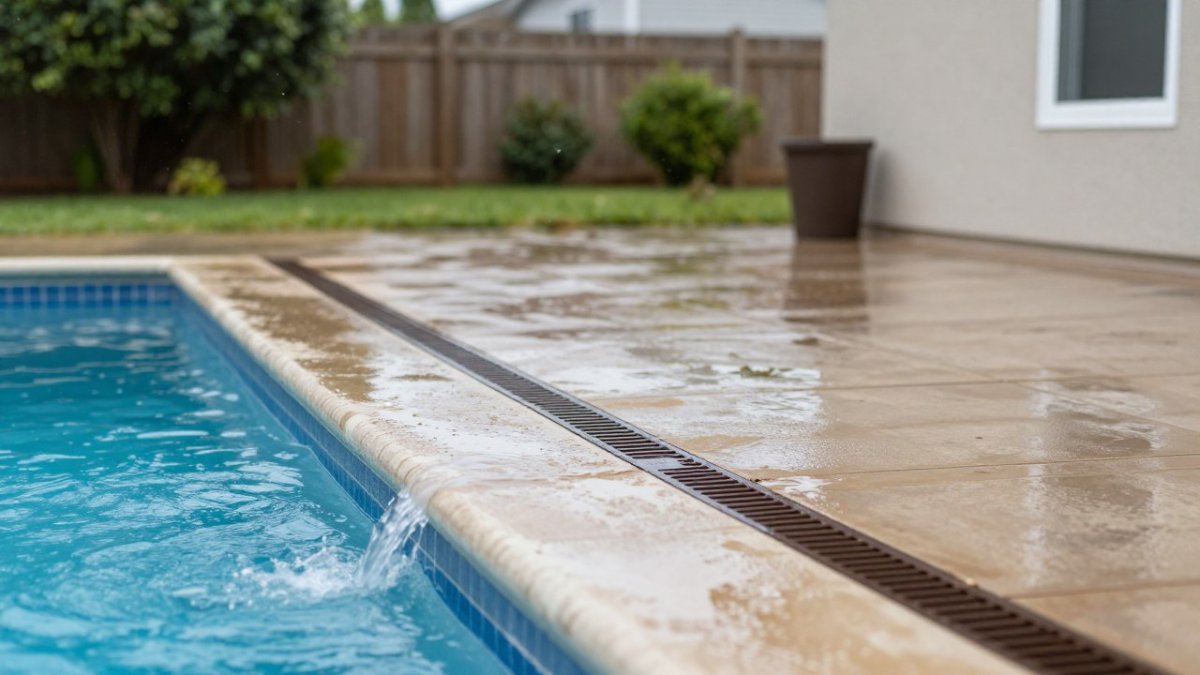
Standing water softens the base, shifts pavers, and stains surfaces. Over time it can undermine the slab and push water toward your foundation.
The fixes we plan for most often:
- Grading the patio so it sheds water away from the house
- Channel drains at low points and along pool edges
- Permeable joint systems that let water pass through
For a deeper look, our complete guide on how to fix standing water in a backyard covers the causes and the repairs.
Permits, Grading, and Construction Risks to Plan For
Permit requirements vary by project type and location, so confirm with the local authority before work starts. Rules vary by city and by project, so confirm before work starts. the U.S. Consumer Product Safety Commission’s pool safety guidance is worth reading if your project touches a pool area.
The bigger risks are quieter. Poor grading, shallow base, and no drainage plan cause most of the failures we are called out to fix.
Prioritizing Patio Upgrades on a Realistic Budget
Start with what protects everything else, then add what you will use most. That order keeps a tight budget from becoming an expensive mistake. The unique angle here is staging: you do not have to build the whole patio at once, and a phased plan often delivers more long-term value than overbuilding for the neighborhood in a single season.
A Staged Sequence That Protects Earlier Spending
- Fix drainage and grading first. Nothing else lasts without it, and redoing a finished surface to correct water problems costs far more than doing it right the first time.
- Repair or replace the base where it has failed. A sound base is the foundation every later upgrade sits on.
- Choose a durable surface you can maintain. Match the material to your soil, climate, and willingness to keep up with joint sand and sealing.
- Add shade, because it multiplies usable hours. A pergola or covered section can roughly double the time you spend outside in hot months.
- Add kitchen, fire, and lighting features as budget allows. These are the highest-use additions once the structure is sound.
A useful rule: spend on structure before decoration. A plain patio with a great base will outlast a fancy one built on a bad one.
How to Estimate Value Without Overpromising
A transparent way to prioritize is to estimate four numbers for each candidate upgrade: total installed cost, ongoing upkeep, likely resale contribution, and cost per year of enjoyment. None of these is a guaranteed dollar-for-dollar return, and no honest contractor should promise one. What the exercise does is show which upgrades pay you back through use even when they do not fully pay back at sale.
- Installed cost includes base, drainage, materials, and labor, not just the visible surface.
- Ongoing upkeep covers sealing, joint sand, cleaning, repairs, and any seasonal service.
- Likely resale contribution should be framed conservatively, based on local buyer expectations rather than a fixed percentage.
That framing lets you compare a shade structure against a fire feature on equal terms, even though they cost different amounts and serve different seasons.
Fit the Upgrade to the Home and the Neighborhood
A common pattern is overbuilding for the block. A kitchen and fireplace that outclass surrounding homes may add enjoyment but rarely recover their cost at sale, while a well-built patio and shade structure that match neighborhood expectations tend to hold value better.
Watch out: phasing a project without a master plan often means paying twice for demolition, drainage tie-ins, or electrical runs that should have been sized for the final design from the start.
To see the range of value-adding hardscape work we handle, review our hardscaping and outdoor living services.
Planning Your Patio Upgrade With a Site Survey
Every good patio starts with a walkthrough, not a catalog.
That is the process we follow at Deck-O-Art. We look at drainage, access, existing structures, and how you want to use the space.
Deck-O-Art is BBB-accredited and fully insured, with a mostly in-house workforce.
A patio is a long-term decision. Treat the planning like one.
Your backyard is either working for you or costing you every season you wait.
Frequently Asked Questions
Do patio upgrades increase home value?
They can, but the effect depends on material quality, workmanship, and how well the patio fits the home and neighborhood. Buyers respond to usable, well-maintained outdoor space, and appraisers weigh condition and durability. A poorly drained or cracked patio can detract from value instead. The stronger case for patio upgrades is the combination of resale appeal and years of daily use before you ever sell.
How long do patio pavers typically last?
Lifespan depends on the paver material, base preparation, and drainage. With a properly compacted base and working drainage, many pavers hold up for decades, and individual units can be lifted and replaced if one cracks or settles. Concrete slabs often last a long time too, but repairs tend to be patchwork and more visible. Ask your contractor how the base and drainage will be built, since those decide how long the surface lasts.
Are patio pavers worth the investment compared with concrete?
Pavers usually cost more upfront than a basic concrete pour, but they offer easier repairs, more design options, and better performance in freeze-thaw and heavy-rain conditions when installed correctly. Concrete is simpler and often cheaper initially, though cracking and resurfacing can add costs later. Compare total lifecycle cost, not just the bid price, and factor in patio paver maintenance such as resealing and joint sand refills.
How can proper drainage extend the life of a patio?
Standing water is the main enemy of any patio. It softens base material, causes settling, feeds weeds in joints, and can push water toward your pool or foundation. Grading the surface away from structures, installing channel or French drains, and directing downspouts properly all reduce that risk. If you already see puddles after rain, address patio drainage solutions before adding finishes, since drainage problems only get more expensive to fix later.
