
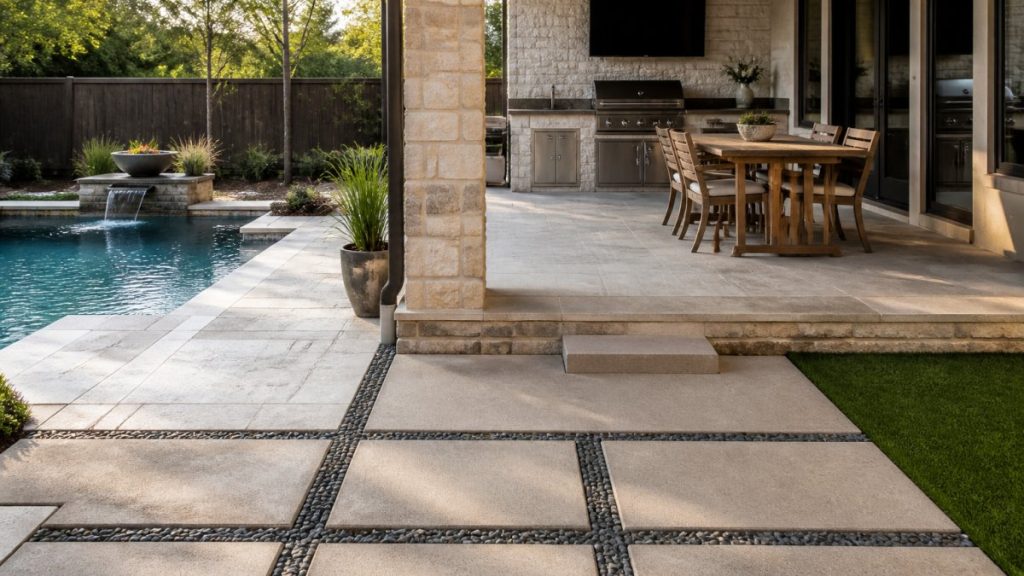
Last Updated: November 2, 2026
Quick Summary
The best materials for North Texas patios are concrete, patio pavers, and natural stone like flagstone or travertine, because each handles heat, UV, and clay soil movement well. Concrete costs least up front, pavers are the most versatile, and natural stone lasts 30+ years. Wood demands the most upkeep here.
- Summers push past 100°F and winter hard freezes drive frost into clay soil.
- Basic broom-finish concrete for 300 sq ft runs $4,500-$7,500 and lasts 25-30+ years.
- Concrete pavers cost $9,000-$16,000 for 300 sq ft and need joints re-sanded every 2-3 years.
- Slope patio surfaces about a quarter inch per foot away from the house.
- Cedar or pressure-treated wood decks last 10-15 years and need refinishing every 1-2 years.
Table of Contents
- What the North Texas Climate Does to Patio Materials
- Concrete Patio Pros and Cons for Local Homes
- Patio Pavers: The Most Versatile Option for DFW Yards
- Natural Stone, Wood, and Metal: How the Other Materials Hold Up
- Heat, UV, and Slip Resistance: Choosing a Surface That Stays Usable
- Patio Drainage Solutions for Heavy Rain and Clay Soil
- Patio Installation Cost and Lifecycle Value
- Get a Site Survey Before You Choose Materials
- Frequently Asked Questions
What the North Texas Climate Does to Patio Materials
Picking the best materials for North Texas patios starts with one fact: your surface has to survive both ends of the thermometer. Summers push past 100°F for days at a time. Winter brings hard freezes that drive frost deep into clay soil. A material that shrugs off one extreme often fails the other.
This guide from Deck-O-Art covers what actually holds up here, and what quietly falls apart. Sun exposure and soil movement are the factors that most often cause damage to outdoor spaces in this region.
Here is the short version. UV resistance decides whether a surface fades or chalks. Heat resistance decides whether you can walk on it barefoot in July. Drainage decides whether it cracks from below.
Most guides treat those as footnotes. In practice, they are the whole decision.
Concrete Patio Pros and Cons for Local Homes
Concrete is the most common patio surface in the region, and for good reason. It generally costs less up front than some alternatives, handles heat well, and needs modest upkeep when it is poured and finished correctly.
The pros:
- Generally lower up-front cost than pavers or natural stone
- Good resistance to UV and color fading
- Straightforward to clean and reseal
- Can be finished with stamped or decorative treatments
The cons matter just as much:
- Hairline cracking is normal as clay soil shifts
- Plain gray looks dated fast
- Standing water damages it quickly if the slope is wrong
- Repairs are visible unless done by hand
A common mistake is pouring over soil that has not been compacted properly. That slab looks fine for a season, then cracks along the same lines every time.
For homeowners who want a decorative finish, contact us for a personalized consultation and site survey.
Patio Pavers: The Most Versatile Option for DFW Yards
Patio pavers are often chosen for flexibility. Individual units can move with the ground instead of fighting it, which generally results in fewer visible cracks than a solid slab.
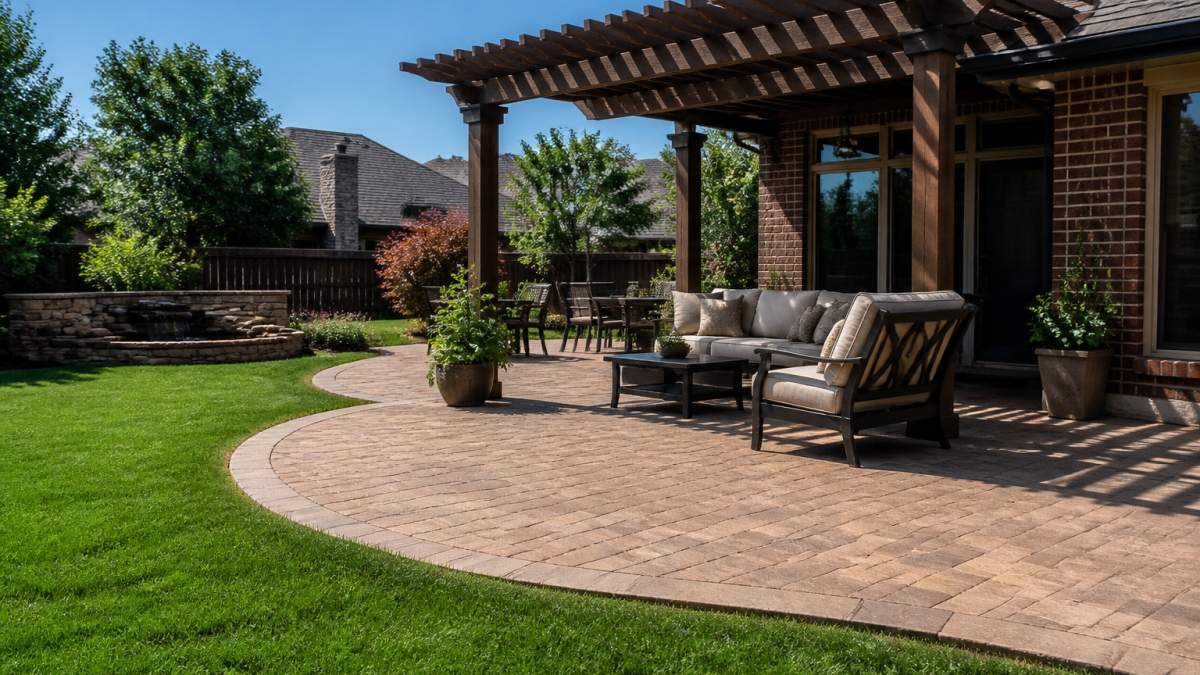
The pros:
- Individual units can be lifted and reset when repairs are needed
- Available in a range of colors, textures, and patterns
- Slip resistance depends on the finish selected
- Service life depends heavily on proper base preparation
The cons:
- Higher material cost than basic concrete
- Weeds can sprout in the joints if sand shifts
- Needs periodic re-sanding
- Poor base work ruins the whole install
Pavers laid on a thin base over unamended clay can heave and settle over time. Base preparation is critical.
If pavers fit your plan, review the patio decking options before you commit to a pattern or color.
Natural Stone, Wood, and Metal: How the Other Materials Hold Up
Natural stone, such as flagstone or travertine, brings high heat resistance and a look that ages well. It stays cooler than concrete under direct sunlight and resists fading. The trade-offs are cost and weight, plus a surface that can chip at the edges.
Wood, whether cedar or pressure-treated, feels good underfoot and stays cooler in hot summers. It also warps, splits, and needs a protective finish every year or two. In this climate, wood demands the most upkeep of any option.
Aluminum and powder-coated metal are mostly used for patio covers and furniture frames. They resist rust and rot well, but they are not a flooring choice.
Synthetic resin and poly furniture follow the same logic: good UV resistance, low maintenance, limited structural use.
Heat, UV, and Slip Resistance: Choosing a Surface That Stays Usable
A surface you cannot walk on in July is a failed surface. Heat resistance and UV resistance are not abstract specs; they decide how much of the year your patio is actually usable.
Concrete and natural stone handle heat well but get hot in direct sunlight. Pavers in lighter tones stay noticeably cooler. Dark colors absorb more heat, so a charcoal paver in full sun will burn bare feet.
Slip resistance matters more than most buyers expect. Smooth stamped concrete turns slick when wet. A textured finish or a broom finish gives grip. Around a pool, that difference is a safety issue, not a preference.
Shade and airflow change the math. A covered patio with a polycarbonate roof or a vinyl cover blocks direct sun and keeps the surface cooler. Lattice walls and open sides keep air moving so heat does not pool.
Patio Drainage Solutions for Heavy Rain and Clay Soil
Clay soil is the real enemy here, and it fails patios in two distinct ways that most guides blur together.
First, expansive clay swells when wet and shrinks when dry. During a wet spring, the soil under and around a patio can expand enough to lift edges and open joints. In a dry summer, it contracts and leaves voids under the slab or paver base. A rigid slab spanning those voids cracks; pavers settle into them. This is why a patio that looked perfect in April can show a hairline crack by August.
Second, heavy rain cannot soak in fast enough. Clay absorbs water slowly, so storm runoff sheets across the yard and pools against the patio edge. That standing water finds every crack and widens it, and repeated wet-dry cycles accelerate the swell-shrink movement above.
Occasional hard freezes add a third stress. Water trapped in joints or under the slab expands when it freezes, heaving pavers and widening cracks. The fix is not a thicker slab, it is keeping water away from the base in the first place.
Good drainage starts before the pour:
- Slope the surface away from the house at a steady grade, a common target is about a quarter inch per foot, falling away from the structure.
- Build a compacted gravel base under the slab or pavers so water has somewhere to move instead of sitting against clay.
- Install channel drains or French drains at low points and where the patio meets the lawn.
- Tie gutter downspouts away from the patio edge so roof runoff does not dump onto the surface.
- Regrade surrounding soil so water runs off, not in, and so it does not pond against the base.
- Use polymeric joint sand on pavers to resist washout and limit water intrusion into the base.
A patio poured flat, or sloped toward the house, will fail no matter which material you choose. Drainage is decided in the base and grade, not in the finish.
If water already sits around your pool or patio after storms, read the full guide to fixing standing water for the step-by-step approach.
Patio Installation Cost and Lifecycle Value
Pricing for patio materials varies with project scope and site conditions. Pricing depends on site access, base depth, drainage work, and finish selection. For current prices or a quote for your project, contact Deck-O-Art directly.
| Material | Typical Installed Cost (300 sq ft) | Expected Lifespan | Ongoing Cost Pattern |
|---|---|---|---|
| Basic broom-finish concrete | $4,500-$7,500 | 25-30+ years with crack control | Reseal every 3-5 years; crack repair as needed |
| Stamped or colored concrete | $8,000-$14,000 | 20-25 years | Reseal every 2-3 years to hold color |
| Concrete pavers | $9,000-$16,000 | 25-30+ years | Re-sand joints every 2-3 years; occasional unit reset |
| Flagstone or travertine | $15,000-$28,000 | 30+ years | Low annual cost; occasional chip or edge repair |
| Cedar or pressure-treated wood deck | $7,000-$15,000 | 10-15 years | Clean and refinish every 1-2 years |
Lifecycle cost matters more than upfront price. Over a 20-year span, the total cost of each material depends on maintenance, repair frequency, and base stability. For a cost comparison specific to your project, contact Deck-O-Art for a quote.
Ask every contractor for a line-item quote that separates base prep, drainage, material, and finish. A low total that skips base depth or drainage is not a lower price, it is a deferred repair.
Before you commit budget, contact Deck-O-Art for guidance on your specific project.
Get a Site Survey Before You Choose Materials
No guide can tell you which material fits your yard. Soil, slope, sun path, and how you use the space decide that, and they are different on every lot.
A site survey catches the problems early: poor drainage, unstable soil, tight access, or a slope that needs correction before anything is laid. Fixing those after installation costs far more.
Our team at Deck-O-Art handles most work in-house, and every project starts with a personalized consultation and site survey.
We are BBB-accredited and fully insured, and we have been in business since 1998.
Contact us to schedule your site survey and get a plan built around your yard, not a template.
Frequently Asked Questions
What is the best material for a patio in North Texas?
There is no single best answer, but pavers and stamped concrete cover most North Texas patios well. Pavers handle clay soil movement and heavy rain better because individual units flex and drain through the joints. Stamped concrete costs less upfront and offers a wide range of finishes. Natural stone suits homeowners who want longevity and are willing to pay more. The right pick depends on how much sun the patio gets, whether it sits around a pool, and how much upkeep you will accept.
Are pavers or concrete better for a patio?
Pavers win on repairability and drainage. If one unit cracks or settles, it can be lifted and reset without touching the rest of the patio. Concrete is a single slab, so a crack or a low spot usually means a larger repair. Concrete costs less to install and needs less joint maintenance. Around a pool or on soil that shifts, pavers are usually the safer long-term choice. On a stable, well-drained site with a tight budget, concrete performs fine.
Which patio materials stay coolest in direct sunlight?
Light-colored pavers, travertine, and lighter stamped concrete stay noticeably cooler than dark materials. Color matters more than material type: a dark gray paver will hold far more heat than a tan one of the same stone. Texture also helps, since a brushed or tumbled finish traps less reflected heat than a polished surface. Around a pool, pair a light color with a slip-resistant finish so the surface stays comfortable and safe underfoot.
How do patio drainage solutions protect a patio in North Texas?
North Texas clay soil absorbs water slowly, so patios need a plan for where rain goes. Common solutions include sloping the surface away from the house, installing channel drains along the patio edge, and using paver joints or permeable base layers that let water pass through. A French drain or dry creek bed can move water away from pool decks and low spots. A site survey before installation identifies the grades and runoff paths so the patio drains correctly from day one.
Choosing patio materials in this climate is a drainage decision as much as a design one. Get the base and slope right, pick a surface that handles sun and heat, and your patio will stay usable for decades. Deck-O-Art brings a full site survey, in-house crews, and drainage expertise to every project. Get started with Deck-O-Art and build an outdoor space that holds up to Texas weather.
