
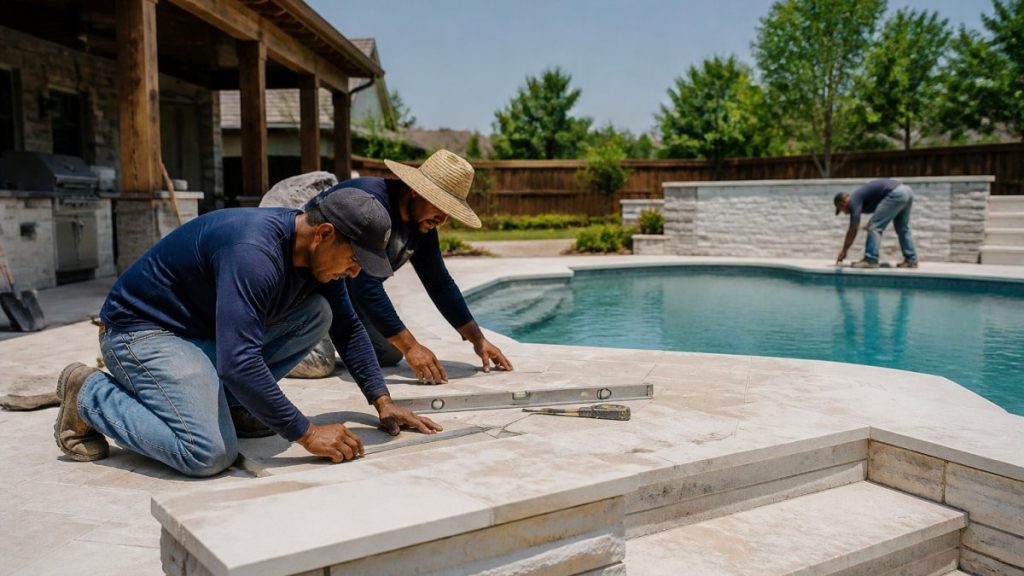
Last Updated: October 26, 2026
Quick Summary
In-house pool contractors keep their own trained crews on payroll instead of handing most work to outside subcontractors, so one company stays accountable from excavation to finish. This gives you tighter scheduling, consistent quality control, and clearer warranty responsibility on your build.
- Deck-O-Art has run a mostly in-house workforce since 1998, keeping finish trades on payroll.
- In-house crews carry fixed costs like wages, insurance, and training, so steady utilization decides pricing.
- Keep trades that drive warranty calls and visible quality in-house; subcontract specialist licensed scopes.
- Ask builders for a phase-by-phase schedule with trade names attached before you sign.
- Ask who supervises the crew and how long the core team has been with the company.
Table of Contents
- What In-House Pool Contractors Actually Means
- In-House Pool Construction vs Subcontractors: The Trade-Offs
- Benefit 1: One Crew Accountable From Excavation to Finish
- Benefit 2: Tighter Scheduling and Fewer Delays
- Benefit 3: Quality Control and Craftsmanship You Can Trace
- Benefit 4: Design, Drainage and Permits Handled Under One Roof
- Questions to Ask Pool Contractors Before You Sign
- What a Realistic Pool Contractor Project Timeline Looks Like
- Frequently Asked Questions
What In-House Pool Contractors Actually Means
In-house pool contractors are pool builders who keep their own crews on payroll rather than handing most of the work to outside subcontractors.
“In-house” gets used loosely in this trade. A builder who self-performs excavation but subs out every finish trade is not really in-house. The distinction is who shows up, who is trained, and who is on the hook when something goes wrong.
Who Is on the Payroll and Who Is Not
Most builders fall on a spectrum, not into two clean buckets. A company can keep its core construction crew on staff and still bring in licensed specialists for electrical, plumbing, or gas work, which is normal and often required by code. What separates a true in-house operation is that the trades touching your visible finished surfaces, deck, tile, coping, water features, are handled by people the company hired, trained, and supervises directly.
In-House Pool Construction vs Subcontractors: The Trade-Offs
Neither model wins on every dimension. In-house pool construction gives you tighter control and clearer accountability, while a heavy subcontractor model can offer flexibility and, in some cases, a lower headline bid. The trade-off shows up in scheduling, quality consistency, cost structure, risk allocation, and who owns a problem when one appears. Most builders run a hybrid, so the useful question is which trades belong on payroll and which belong on a subcontract.
Pros and Cons of Each Delivery Model
| Factor | In-House Crew | Heavy Subcontractor Model |
|---|---|---|
| Accountability | One company owns the outcome | Split between trades |
| Scheduling | Crews coordinated internally | Dependent on sub availability |
| Quality control | Supervised to one standard | Varies by crew |
| Craftsmanship | Trained and retained by the builder | Inconsistent across jobs |
| Flexibility | Limited by crew capacity | Scales up and down quickly |
| Upfront bid | Often higher | Sometimes lower |
| Cost structure | Fixed payroll and benefits, high utilization required | Variable cost per job, markup built into each sub bid |
| Risk and liability | Builder carries workers’ comp, general liability, and warranty exposure directly | Risk is contractually shifted, but warranty responsibility can blur across trades |
| Staffing | Recruiting, training, and retention are ongoing costs | Access to specialist labor without hiring |
| Scalability | Grows one hire at a time | Grows one purchase order at a time |
| Best-fit projects | Repeatable, finish-heavy work where consistency pays | Specialty trades, peak-season overflow, one-off scopes |
A common mistake is comparing bids on price alone. The lower number frequently reflects a thinner crew and more handoffs, and handoffs are where schedule delays and rework tend to start.
The Cost Math Behind the Decision
The headline bid is the least useful number here. What matters is total cost of delivery, and the two models load costs in different places.
An in-house crew carries fixed costs: wages, payroll taxes, workers’ compensation, general liability, tools, trucks, training, and supervision.
A subcontractor model converts much of that fixed cost into variable cost.
A practical rule many builders use: keep the trades that touch visible finished surfaces and drive warranty calls on payroll, and subcontract specialist scopes where licensing, code, or low volume makes full-time staffing hard to justify.
Risk, Liability, Insurance, and Warranty
Risk allocation is where the two models diverge most sharply, and the part owners understand least.
With an in-house crew, the builder carries workers’ compensation, general liability, and the warranty obligation directly. There is no contractual gap between the entity that performed the work and the entity that stands behind it.
With a heavy subcontractor model, risk is shifted by contract, but shifting risk is not the same as eliminating it.
When Each Model Makes Sense
The framework comes down to project volume, complexity, seasonality, and how much of the scope is specialist work.
- High, steady volume with repeatable scopes: in-house wins on cost per job and consistency.
- Seasonal peaks and valleys: a hybrid protects margin in the slow months.
- Complex or specialty scopes (electrical, plumbing, gas, engineered structures): subcontracting to licensed specialists is often required by code and is the safer call.
- Finish-heavy work where the customer sees every detail: in-house crews pay for themselves in fewer callbacks.
- One-off or unusual projects: renting specialist capacity beats hiring for a skill you will not use again.
The right question is not “in-house or subcontractor” but “which trades belong on payroll.” Keep the work that drives warranty calls and visible quality in-house; subcontract the specialist scopes where licensing and low volume make staffing impractical.
Benefit 1: One Crew Accountable From Excavation to Finish
The clearest advantage of in-house pool contractors is a single point of accountability.
This is where the delivery model becomes tangible. You can see the actual swimming pool and spa construction service an in-house crew delivers, and evaluate whether that level of control fits your project.
Best for: Owners who want one throat to choke when issues arise.
Skip if: You are optimizing purely for the lowest initial quote.
Benefit 2: Tighter Scheduling and Fewer Delays
Scheduling is where the two models diverge fastest. A builder with its own crew can sequence phases without waiting in another company’s queue. When excavation finishes early, the crew moves to the next phase instead of idling until a subcontractor’s calendar opens up.
The thing nobody tells you about subcontractor-heavy builds is how much time gets lost to coordination gaps. Each trade has its own backlog, and a two-day slip from one sub can cascade into a two-week delay.
Where the Time Actually Goes
A pool build runs through predictable phases: consultation and site survey, design and permitting, excavation, structural rough-in, gunite or shotcrete, finishes, and startup.
In a subcontractor-heavy build, every link is a separate company with its own backlog. Excavation finishes and the steel crew is booked another week; steel finishes and the plumber’s calendar opens three days later.
An in-house crew removes most of that waiting. The same supervisor who ran excavation knows the steel crew is available because the steel crew is on the same payroll.
The Coordination Tax
Every handoff between companies carries a coordination cost: a phone call, a site visit, a schedule confirmation, a re-inspection. Individually small, across five or six trades they compound into a coordination tax on the timeline.
In-house crews do not eliminate coordination, they internalize it. The supervisor coordinates with people who report to the same company, which means a schedule change is a conversation, not a negotiation.
Ask any builder for a phase-by-phase schedule with trade names attached. If the schedule lists trades without naming who performs them, you cannot tell whether the timeline depends on one company’s calendar or five.
What This Means for Your Project
Tighter scheduling is not just a convenience. A shorter build means less time with an open excavation, fewer weather windows that can disrupt finishes, and less exposure to price and availability changes. For homeowners financing a build, the interest clock also runs for fewer months.
The benefit is real but conditional: it depends on the builder actually keeping the crew busy and supervised. A builder with an in-house crew that is overbooked can schedule just as poorly as a subcontractor-heavy operation.
Benefit 3: Quality Control and Craftsmanship You Can Trace
Quality control in a pool build is not a single inspection. It is dozens of small decisions: how a deck edge is finished, how tile is set, how a grade is pitched for water circulation.
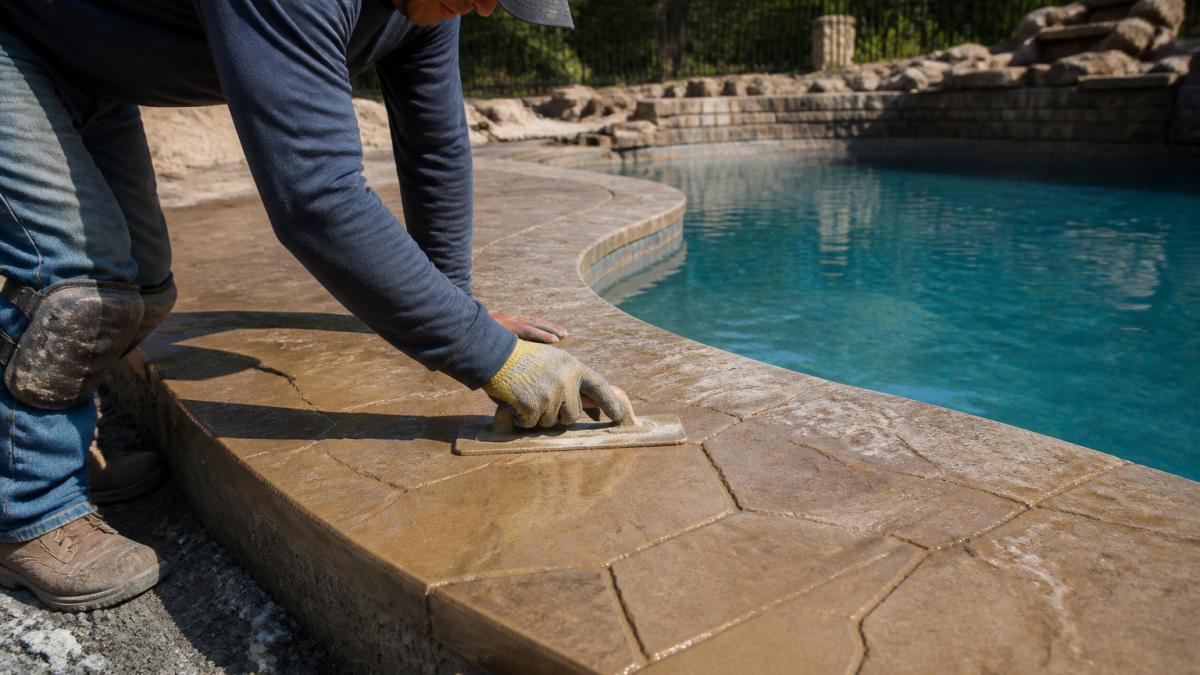
Craftsmanship you can trace means you can ask who did a specific piece of work and get a real answer. That traceability matters when you need maintenance instructions later or when a warranty question comes up.
Benefit 4: Design, Drainage and Permits Handled Under One Roof
Design planning, drainage, and permits are three separate skill sets that must line up before construction starts. Handling them under one roof removes the gaps where a design gets approved but the drainage was never engineered for the site. Site assessment and landscape integration happen with the same team that will build the pool.
Drainage deserves special attention. You can review the dedicated drainage solutions for pools and spas to see how that work is scoped. If you want to visualize the layout before committing, the 3D renderings service shows the design and spatial relationships up front.
Questions to Ask Pool Contractors Before You Sign
The right questions expose the delivery model fast. Ask directly: “Do you do the work yourselves, or do you bring in subcontractors?” Then ask who supervises the crew, how long the core team has been with the company, and what happens if a problem appears a year after completion.
Ask about permits and building codes too. Regulatory compliance is not glamorous, but a builder who handles permits in-house usually understands the local inspection rhythm. For a deeper set of vetting criteria, our guide on hiring pool contractors in McKinney TX walks through the full checklist.
What a Realistic Pool Contractor Project Timeline Looks Like
A pool contractor project timeline runs through predictable phases: consultation and site survey, design and permitting, excavation, structural work, finishes, and startup. Each phase depends on the one before it, which is why schedule coordination matters more than any single step. In-house crews move between phases faster because they are not waiting on outside calendars.
When you are ready to talk through your own project and get a realistic timeline, you can contact our team to start with a consultation and site survey.
Frequently Asked Questions
What are the benefits of hiring a pool contractor with an in-house crew?
The main benefits of in-house pool contractors are accountability and continuity. The same company that designs the project also schedules the excavation, shell work, decking and finish, so there is no gap between trades blaming each other for delays. You get one point of contact, one warranty to call, and a crew that already knows the site. It also tends to reduce schedule delays, because the builder is not waiting on an outside crew’s calendar to free up before the next phase can start.
How do in-house pool contractors differ from subcontractors?
An in-house crew works directly for the pool contractor as employees, while subcontractors are separate businesses hired per phase. In an in-house pool construction vs subcontractors comparison, the in-house model gives the builder direct control over scheduling, training and quality checks. The subcontractor model can be cheaper on paper and gives access to specialist trades, but you inherit more coordination risk. Ask any builder which phases they self-perform and which they outsource, and get that answer in writing before signing.
Does an in-house pool crew make a project finish faster?
Often, yes, but the reason matters more than the claim. A pool contractor project timeline depends on weather, permits and inspection sign-offs as much as labor. An in-house crew removes one common delay: waiting for an outside trade to fit your job into their schedule. Ask the builder for a phase-by-phase schedule with inspection milestones, and ask what happens to that schedule when rain shuts the site down for a week. A realistic answer is a better sign than a fast one.
What should I ask a pool contractor before signing a contract?
Start with who does the work: what percentage is self-performed versus subcontracted, and who supervises each phase. Then ask for proof of insurance and licensing, a written scope covering decking, drainage and equipment, a payment schedule tied to completed milestones rather than dates, and the warranty terms in writing. Also ask how change orders are priced and who handles permit applications. Any contractor who cannot answer these plainly is telling you something useful.
Picking the right builder is really a question of who you want accountable when the work gets hard. Deck-O-Art has kept a mostly in-house workforce since 1998, is BBB-accredited, and is fully insured, so the crew that designs your project is the crew that builds it. Get started with Deck-O-Art and a personalized consultation and site survey that turns your backyard into a space built to last.
