
Last Updated: October 28, 2026
Quick Summary
A pool deck crack usually starts below the surface, in a poorly compacted base, missing reinforcement, bad curing, or joints never given room to move. Fix the visible line without fixing the cause and the crack returns within a season. First decide whether the crack is still moving or has stopped.
- Hairline cracks thinner than a credit card are usually normal shrinkage, not structural damage.
- Mark crack ends with a pencil and recheck after a wet-dry cycle to see if it is active.
- A vertical offset or lip means settlement, so diagnose the base before patching.
- Do not seal a crack that is still moving; a widening crack will tear any patch apart.
- Call promptly if you can fit a coin on edge into the crack or gaps open at the coping.
Table of Contents
- Start With What the Crack Is Telling You
- Common Causes of a Pool Deck Crack
- Hairline Cracks in Concrete Pool Decks: Normal or Not?
- Pool Deck Settling Cracks and Uneven Movement
- Pool Deck Expansion Joints and Control Joint Spacing
- Concrete Pool Deck Crack Repair: Matching the Method to the Crack
- When to Call a Professional About a Pool Deck Crack
- Frequently Asked Questions
Start With What the Crack Is Telling You
A crack in your pool deck is not random damage. It is a message about what is happening underneath the concrete, and learning to read that message saves you money.
The uncomfortable truth most guides skip: the crack you see rarely starts at the surface.
So before you buy a tube of sealer, answer one question: is this crack still moving, or has it stopped?
Common Causes of a Pool Deck Crack
The causes fall into a few clear groups: a bad base, weak reinforcement, poor curing, and movement the slab was never allowed to make.
- Base problems: soft fill, poor compaction, or soil that shifts with water
- Reinforcement gaps: missing or misplaced wire mesh or rebar
- Curing mistakes: concrete drying too fast in the heat
- Movement: settlement, tree roots, or a deck tied too tightly to the pool
North Texas soil is a big part of the story. Clay-heavy ground swells with rain and shrinks in a dry spell. A slab on that soil without a properly compacted base will flex, and flexing concrete cracks.
Base Preparation and Compaction
A concrete slab is only as good as what sits under it. Base preparation means excavating to the right depth, adding a graded gravel base, and compacting it in lifts until dense and level. Readers who want it done right can see the concrete installation services in McKinney TX.
A common mistake is pouring over old fill or disturbed soil without re-compacting. The concrete looks fine for a year, then a crack opens along the soft spot.
Reinforcement and Curing
Reinforcement is the steel inside the slab, either welded wire mesh or rebar. It does not stop cracks from starting; it holds the concrete together so cracks stay tight instead of spreading.
Curing is the other half. Concrete does not dry to get strong; it cures, and needs moisture to do that. In hot, dry weather the surface can lose water faster than the mix can set, causing early cracking, sometimes within a day of pouring.
Hairline Cracks in Concrete Pool Decks: Normal or Not?
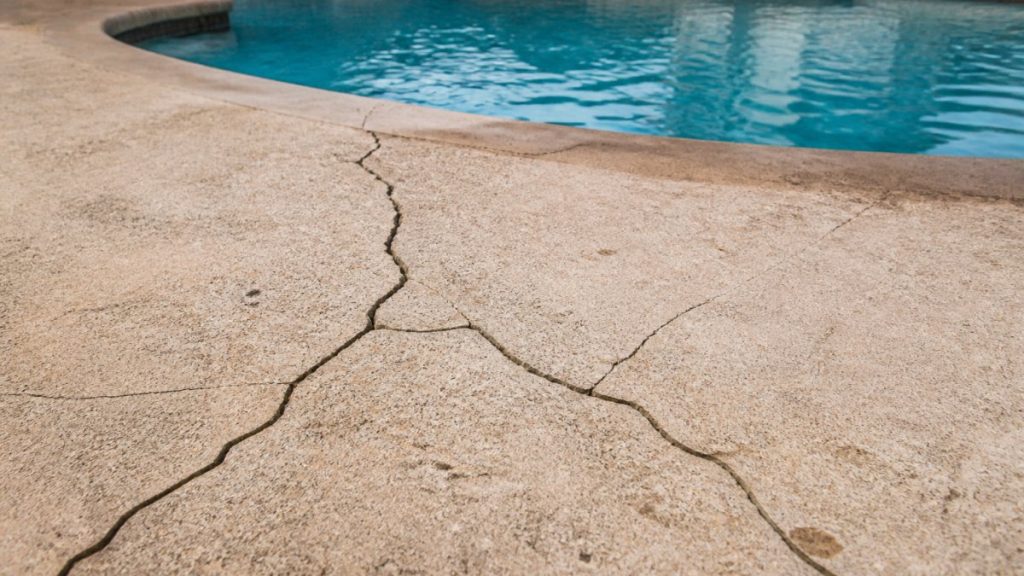
Hairline cracks in concrete pool decks are usually normal, not structural. They are thin surface cracks, often less than the width of a credit card, and come from shrinkage as the concrete cures, the concrete losing water and pulling in slightly as it sets.
So how do you tell normal from not normal? Use this quick check:
| What You See | Likely Meaning | What To Do |
|---|---|---|
| Thin, tight lines, no widening | Normal shrinkage | Monitor, seal to keep water out |
| Cracks that keep getting wider | Active movement | Diagnose the cause before patching |
| Cracks with a vertical offset | Settlement | Call a professional |
| Cracks along the deck-to-pool edge | Movement at the bond | Inspect the joint |
The key word is progression. A hairline crack that looks the same next summer is fine. One that lengthens, deepens, or widens means something is still moving.
Pool Deck Settling Cracks and Uneven Movement
Pool deck settling cracks happen when the ground under part of the slab drops away. The concrete loses support on one side and cracks along the weak line.
Uneven settling shows up in a few ways:
- A visible step or lip where two sections meet
- Cracks that run in a line toward the pool or the house
- Gaps opening between the deck and the pool coping
- Gaps between the deck and the house foundation
Those gaps matter. A widening gap between the deck and the pool, or the deck and the house, means the slab is pulling away from a fixed point, underlying movement, and your cue to stop patching and start diagnosing.
Pool Deck Expansion Joints and Control Joint Spacing
Pool deck expansion joints and control joints are the planned lines that let concrete move without cracking in random places.
Joint spacing is where a lot of decks go wrong. Joints set too far apart leave too much concrete between them, and the slab cracks in the middle instead of at the joint.
If your deck has few or no visible joints, that alone can explain a crack running through the middle of a slab.
Concrete Pool Deck Crack Repair: Matching the Method to the Crack
Concrete pool deck crack repair works best when the method matches the crack type. For readers who want the work handled, pool and patio decking in McKinney TX covers the service and booking.
| Crack type | Observable clues | First move | Repair method | Typical scope |
|---|---|---|---|---|
| Dormant hairline | Tight, under about 1/16 inch, unchanged for a season | Clean and seal | Polyurethane or epoxy crack sealant, backer rod in wider lines | DIY-friendly; a few tubes and a caulk gun |
| Active shrinkage or joint crack | Widens and narrows seasonally, runs to a joint | Route and seal | Saw-cut or rout the line, install flexible sealant | Small contractor job |
| Settlement with a lip | One side lower, straightedge rocks, gap at coping | Diagnose base first | Slab lifting (mudjacking or polyurethane foam injection) or section replacement | Mid-size project; access and demolition drive cost |
| Structural or widespread | Multiple wide cracks, offsets, gaps at pool and house | Stop patching | Engineer assessment, then partial or full replacement | Largest scope; permit and inspection likely |
Match the fix to what you found:
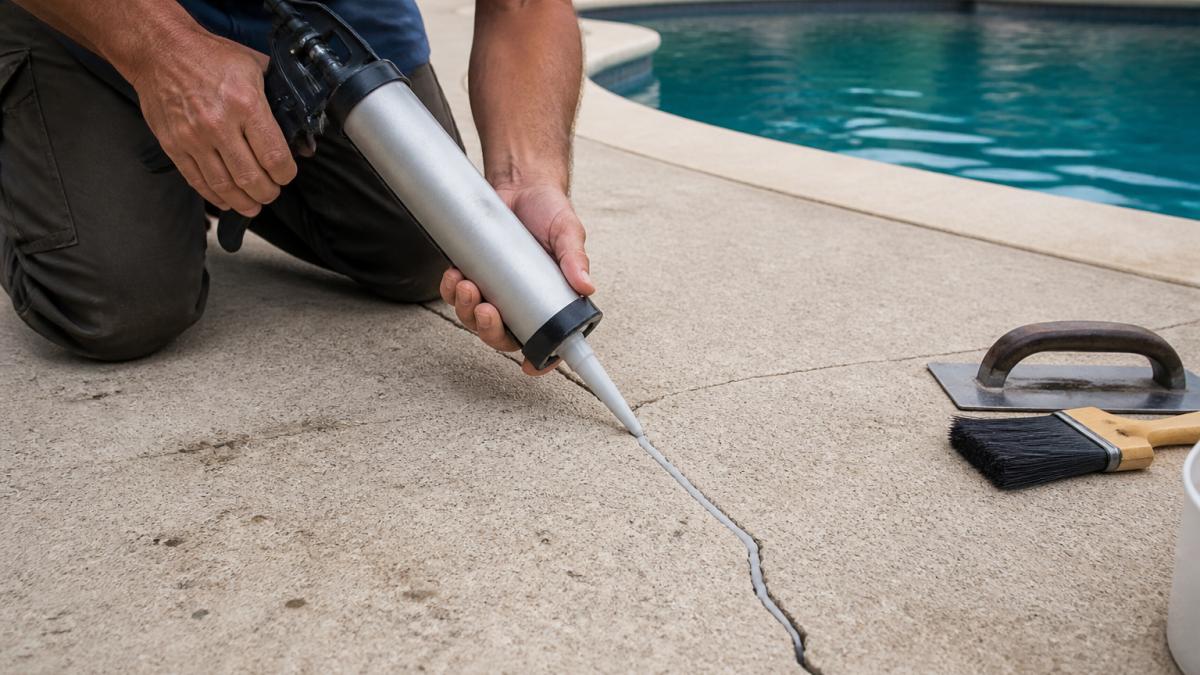
- Dormant hairline cracks: clean the line and seal it to keep water out. This is maintenance, not structural repair. A polyurethane sealant stays flexible and handles minor thermal movement better than a rigid patch.
- Active cracks: find and fix the cause first, then repair. Sealing an active crack hides the problem. If the crack runs to a control joint, the joint may need re-cutting and refilling with a flexible sealant.
- Settlement cracks with a lip: the slab needs to be leveled or the section replaced. Patching alone will not fix a step. Slab lifting injects material under the slab to raise it back toward grade; replacement removes and re-pours the affected section.
- Cracks at joints: re-cut or widen the joint and refill it with a flexible sealant. A joint that was never cut, or cut too shallow, is a common reason a crack appears mid-slab.
What Drives the Cost
Repair pricing is not one number. It scales with crack length and width, how many cracks are active, whether the slab must be lifted or removed, equipment access, and finish matching. Most homeowners face one of three tiers: a DIY seal of a few hairline cracks is a low-cost maintenance item measured in tubes of sealant; a contractor routing and sealing several active cracks is a modest project; slab lifting or section replacement with finish matching is the largest, since demolition, base repair, and re-pouring all enter the estimate.
Patching, Overlays, and When Demolition Makes Sense
Patching fills a single crack. An overlay is a thin new layer of concrete or a stamped coating applied over the whole deck to resurface it. Resurfacing can hide hairline cracks and refresh the look, but only if the slab underneath is sound and stable.
Demolition makes sense when the slab is badly broken, settlement has created real steps, or the base itself has failed. When teardown is the answer, demolition and debris hauling in McKinney TX handles the removal. If you are weighing an overlay against full replacement, our stamped concrete overlay how-to walks through the process.
Do not seal a crack that is still moving. A flexible sealant can accommodate minor movement, but a widening settlement crack will pull any patch apart and let water in through the failed repair. Diagnose first, repair second.
When to Call a Professional About a Pool Deck Crack
Not every crack needs a pro, but some need one now. If you are ready to hire, this guide to hiring pool contractors in McKinney TX walks through choosing one. Use this urgency framework to decide how fast to act.
Call promptly, same week:
- A crack is visibly wider than when you first noticed it, or you can fit a coin on edge into it.
- One side of the crack sits lower than the other, creating a step or lip.
- Gaps are opening between the deck and the pool coping, or between the deck and the house.
- Water pools on or near the crack after rain instead of draining away.
- The crack runs through or near the pool shell, skimmer, or return fittings.
Call soon, within a month:
- Multiple hairline cracks are appearing across the deck at once.
- A previously sealed crack has reopened.
- The deck feels hollow or sounds different underfoot near the crack.
Monitor, no call yet:
- A single tight hairline crack that has not changed in a season. Mark the ends with a pencil and check again after the next wet-dry cycle.
Safety Hazards a Crack Can Create
A crack is not only cosmetic. A vertical offset of even a fraction of an inch is a trip hazard around a wet pool deck, where footing is already uncertain. Widening cracks can expose sharp aggregate edges that cut bare feet. Cracks crossing the deck’s drainage slope can dam water against the pool or house, and standing water accelerates the soil movement that caused the crack.
What a Proper Inspection Checks
A professional inspection looks at more than the crack. It checks the base and whether the slab is supported, the joint layout and whether joints were cut and spaced correctly, the drainage slope and where water goes, and how the deck meets the pool and house. Drainage is often the hidden driver, since water pooling around the deck softens soil and speeds settlement.
The patch fails, water gets in, and the damage grows through a freeze-thaw cycle. Diagnose the movement first, then choose the repair.
Frequently Asked Questions
Are hairline cracks in a pool deck normal?
Yes, thin hairline cracks are common and usually cosmetic. They typically come from shrinkage as concrete cures or from minor surface stress. A crack wider than a credit card edge, one that keeps lengthening, or one with vertical displacement on either side is a different story and deserves a professional inspection. Keep an eye on hairline cracks in concrete pool decks so you notice any change in width or depth early.
How can I tell if a pool deck crack is structural?
Look for three signs: the two sides of the crack sit at different heights, the crack is wider than about 1/4 inch, or it keeps getting longer and deeper over a few months. Also check whether the gap between the deck and the pool coping or the house wall is changing. Any of these points to underlying movement rather than surface shrinkage, and a contractor should assess it before you spend money on cosmetic repair.
Can soil settling cause pool deck cracks?
Yes. Pool deck settling cracks often trace back to soil that was not compacted properly before the slab was poured, or to soil washing out under the deck over time. Water from poor drainage makes it worse. In North Texas, clay soils expand and contract with moisture, which adds movement. Repairing the crack without addressing the base or drainage usually means the crack returns.
When should I call a professional about a pool deck crack?
Call a professional when a crack is wider than 1/4 inch, when the deck surface is uneven, when water pools near the crack, or when the crack appeared within days of a new pour. A contractor can check joint spacing, drainage, and base condition, then recommend concrete pool deck crack repair that fits the cause. Early inspection usually costs less than waiting for a small crack to become a trip hazard or a structural problem.
