
Table of Contents
- Why Hiring Pool Contractors in McKinney TX Requires Extra Care
- McKinney Permits, Inspections, and Pool Barrier Rules
- Questions to Ask a Pool Contractor Before You Sign
- How to Do a Pool Contractor Estimate Comparison
- Checking Pool Contractor References and Reviews
- What Belongs in a Pool Renovation Contract
- Local Risks That Affect Your Pool Project
- Conclusion
- Frequently Asked Questions
Last Updated: October 8, 2026
Why Hiring Pool Contractors in McKinney TX Requires Extra Care
Hiring pool contractors in McKinney TX is different from hiring almost any other trade: the work is expensive, mostly buried or underfoot, and hard to judge until months after the crew leaves.
Homeowners rarely get burned by a bad tile color. The Texas Department of Licensing and Regulation regulates several trades that touch your backyard, and the Federal Trade Commission’s guidance on home improvement scams is blunt about how often homeowners pay deposits for work that never gets finished.
A pool contractor is a licensed or registered professional who designs, builds, renovates, or repairs swimming pools and the surrounding hardscape.
Below is the exact process we would use if we were hiring someone for our own backyard: permits, verification, bid comparison, references, contracts, and local risks that catch out-of-area builders off guard.
McKinney Permits, Inspections, and Pool Barrier Rules
McKinney requires permits for pool construction and most major renovations, with inspections at defined stages rather than once at the end. Your contractor should pull those permits in their own name, not yours, a homeowner-pulled permit makes the homeowner the responsible party when something fails inspection. If a contractor offers to “let you pull it,” that is a signal about accountability.
The Permit Types You Will Actually See
Most residential pool work falls into a few buckets, which determine approval time and inspection count:
- New pool construction. A building permit plus separate trade permits for electrical, plumbing, and gas, with inspections at pre-gunite or pre-shotcrete, steel and bonding, rough electrical and plumbing, and final.
- Structural renovation. Replacing a shell, adding a spa, or changing the footprint typically triggers a building permit and re-inspection of affected systems.
- Equipment replacement. A new pump, filter, heater, or salt system may require a permit if the electrical or gas connection changes. A like-for-like swap often does not; a relocated heater usually does.
What the Inspection Stages Look Like
A typical new-pool sequence runs roughly in this order, though exact stage names depend on your scope:
- Pre-construction / layout. Setbacks, easements, and the excavation footprint are confirmed before anyone digs.
- Excavation and steel. Rebar placement and the bonding grid are inspected before concrete or gunite goes in, the inspection you cannot undo later.
- Rough plumbing and electrical. Conduit, bonding, and equipment pads are checked before backfill.
- Pre-deck. Grading, drainage, and any deck sub-base are reviewed before the finish surface is poured or laid.
- Barrier / safety. Fence height, gate self-closing and self-latching hardware, and any required alarms or covers are verified.
- Final. All systems are checked together, and the permit is closed out.
If a contractor cannot say which stages apply to your project and roughly when each happens, they have not done this often enough in this jurisdiction.
Barrier and Safety Requirements
Pool barriers are the most commonly failed inspection item and the one most likely to matter at resale. Generally, the requirement is a fence or wall of minimum height with no climbable gaps, a self-closing and self-latching gate, and hardware a small child cannot reach; some configurations also require an alarm, safety cover, or door-and-window alarm on the house side.
Setbacks, Easements, and Impervious Cover
Two lot-level constraints catch homeowners off guard:
- Setbacks and easements. Pools, equipment pads, and sometimes decking must stay clear of property lines, utility easements, and drainage easements. A survey is often the fastest way to confirm what you have to work with.
- Impervious cover. Many lots limit how much of the property can be covered by hard surfaces. A large deck plus a pool plus a driveway can push you over that limit, and the fix is usually a redesign, not a variance.
Who Pulls the Permit, and Why It Matters
The permit should be pulled by the licensed contractor performing the work, in their name. That keeps legal responsibility for code compliance with the party who controls the workmanship, and ties the inspection record to their license for the city and any future buyer.
Confirm in writing:
- Who pulls the permit and pays the fee
- Which inspections are required and at what stages
- Barrier, gate, and safety requirements for your lot
Rules change, and we do not quote fees or code sections from memory. Check the City of McKinney building and permitting information for current requirements before you sign anything.
If a contractor says permits “aren’t necessary for a resurface” or offers to skip inspection, walk away. Unpermitted pool work can surface years later during a home sale, and the cost of correcting it usually lands on you.
Ask your contractor for the permit number once it is issued, then look it up yourself. A permit that exists in the city’s system in the contractor’s name is one of the simplest ways to confirm you are dealing with a legitimate operation.
Questions to Ask a Pool Contractor Before You Sign
Ask about licensing, insurance, subcontractors, payment schedule, warranty terms, and who will actually be on site. The answers tell you more than any portfolio photo, price is the least informative answer you will get.
License, Insurance, and Subcontractor Verification
Ask for the license or registration number, then verify it yourself through the state rather than accepting a photocopy. For insurance, request a certificate and call the carrier to confirm the policy is active and covers the work.
The subcontractor question is the one most homeowners skip. Deck-O-Art runs a mostly in-house workforce for exactly this reason: when the same crew handles demolition, prep, and finish, there is no finger-pointing between trades.
Red Flags That Should End the Conversation
- Cash-only payment requests or pressure to pay a large deposit up front
- No physical local address, or a phone number that only reaches an answering service
- Unwillingness to provide a written contract with a defined scope
Ask each contractor for the name of the person who will be on site daily. Then ask that person a technical question during the walkthrough. If the salesperson cannot answer and no supervisor is named, you have found your answer.
How to Do a Pool Contractor Estimate Comparison
A fair estimate comparison means matching scope to scope, not price to price.
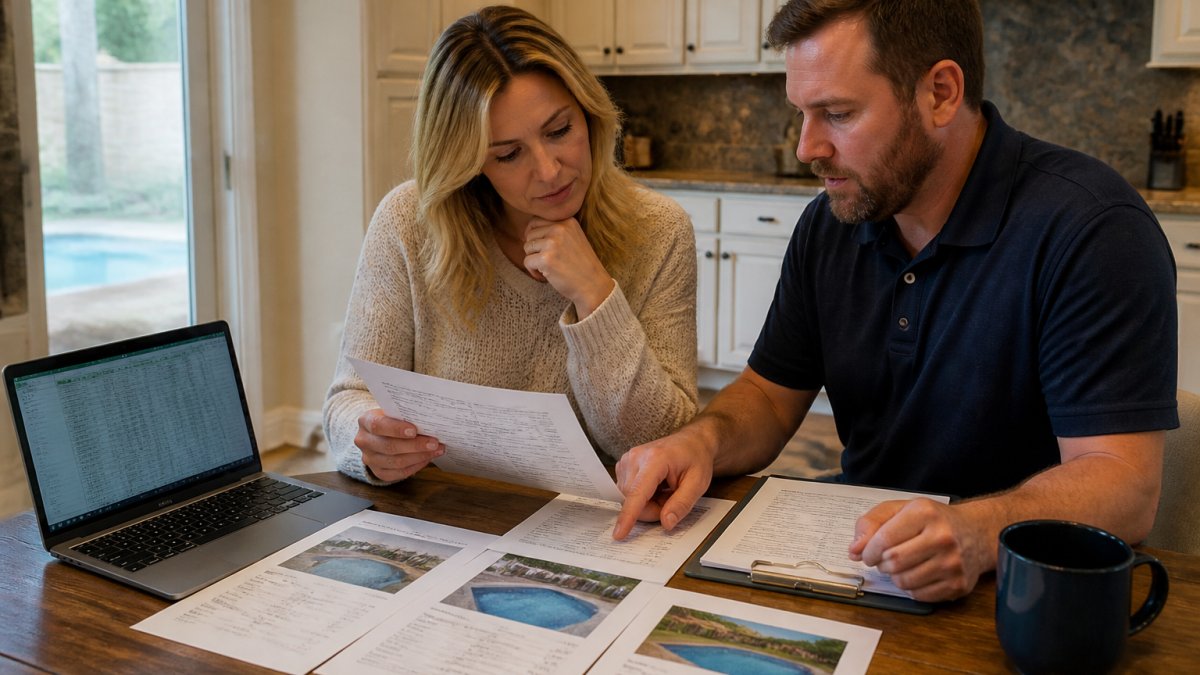
Rewrite every bid into a single table with identical line items. If a contractor will not break out their pricing, that bid cannot be compared fairly.
| Line Item | Bid A | Bid B | Bid C |
|---|---|---|---|
| Permit pulled by contractor | Yes / No | Yes / No | Yes / No |
| Excavation and haul-off included | |||
| Drainage or grading addressed | |||
| Decking material and thickness | |||
| Equipment brand and model | |||
| Warranty length, parts and labor | |||
| Payment schedule tied to milestones | |||
| Site cleanup and debris removal |
If a bid leaves a row blank, ask why in writing. “That’s included” is not an answer; a line item is.
The cheapest bid is almost never the cheapest project. Compare what each contractor excludes, then price those exclusions separately. That number is your real comparison.
Checking Pool Contractor References and Reviews
Ask for three references from jobs completed in the last 12 months, then call and ask about the punch list, not the finished product. Anyone can show you a beautiful pool on the day it is filled. The useful questions are the uncomfortable ones:
- Did the crew show up when they said they would?
- How was the project handled when something went wrong?
- Was the final invoice close to the original estimate?
Then check the public record. Look at review platforms, the Better Business Bureau profile, and any state complaint history. Read the negative reviews first and look for patterns: scheduling, communication, and warranty response come up far more often than workmanship.
Deck-O-Art is BBB-accredited and fully insured, and we would rather you verify that than take our word for it. That is the standard to hold every contractor to.
What Belongs in a Pool Renovation Contract
A pool renovation contract should define scope, materials, schedule, payment milestones, change-order procedure, and warranty terms in writing. Most homeowners read the price and skim the rest, the rest is where disputes live. Here is what we would insist on seeing before signing.
Scope and Specifications
The scope should be specific enough that two people reading it would build the same pool:
- Materials by name and grade. Not “premium tile” but the manufacturer, line, and color. Not “standard decking” but the material, thickness, and finish.
- Equipment by brand and model number. A pump is not a pump. Model numbers let you compare bids and confirm what was installed.
- Dimensions and layout. Length, width, depth profile, and the position of steps, benches, and skimmers.
If a line item is vague, get it in writing before you sign. “That’s included” is not a specification.
Payment Schedules Tied to Milestones
Tie payments to completed work, not calendar dates. A common structure is a deposit at signing, then payments at demolition, rough-in, and substantial completion, with a final payment held until the punch list is signed off. A few principles:
- Keep the deposit modest. A large up-front payment shifts risk onto you before any work exists to inspect.
- Never pay ahead of progress. If a payment is due “on the first of the month,” you have lost the leverage that comes from paying for finished work.
- Hold a meaningful final payment. The last payment is your only real leverage on punch-list items. Once it clears, your ability to get small items fixed drops sharply.
Change Orders: The Budget’s Quiet Killer
Change orders are where budgets break quietly: a verbal “we’ll just add that” becomes a line item at the end, when the work is done and the price is set. Require any change in writing before work begins, with three things:
- A description of the change. What is being added, removed, or substituted.
- A price. Not a range, a number, or a clearly stated unit price if the quantity is uncertain.
- A schedule impact. Does this add days, and how many?
No written change order, no change. That single rule prevents most end-of-project disputes.
Warranties: What to Look For
Warranty terms should state what is covered, for how long, and who performs the repair. Vague brochure promises are not a warranty. Ask specifically:
- What is covered. Workmanship, materials, equipment, or all three? These are often separate warranties with separate terms.
- How long. Workmanship warranties are typically shorter than manufacturer equipment warranties. Know which is which.
- Who honors it. If the manufacturer covers the pump but the installer covers the plumbing, you need both names and both processes.
What to Do Before You Sign
- Read the entire contract, including the fine print on the back.
- Confirm the contractor’s license or registration number is on the document.
- Confirm the insurance certificate is current and names the correct entity.
Never pay the full balance before the punch list is complete and inspected. Once the final payment clears, your leverage to get small items fixed drops sharply.
The contract is not paperwork, it is the plan for how the project will be governed. The time you spend reading it is the cheapest insurance you will buy on the whole job.
Local Risks That Affect Your Pool Project
North Texas soil, drainage, and summer weather create risks out-of-area builders routinely underestimate. Clay-heavy soil shifts with moisture, and a pool deck that ignores drainage will crack or settle within a few seasons. The three issues we see most:
- Drainage. Water that pools against a deck or patio finds its way under it. Grading and drainage planning belong in the original scope, not a repair call two years later.
- Access. Tight side yards and fence lines limit what equipment can reach the excavation area. Ask how the contractor plans to get machinery in and debris out.
- Weather windows. Summer heat and spring storms compress the working season. A realistic schedule accounts for both.
Deck-O-Art handles drainage as part of the outdoor living scope, because a beautiful deck that holds water is not a finished job.
Conclusion
The hardest part of hiring pool contractors in McKinney TX is not finding someone who will take the job. It is finding someone who will still answer the phone a year after the last invoice clears.
Verify the license and insurance yourself. Compare bids line by line. Read the contract before you sign it. Those three habits prevent most of the problems we get called out to fix.
Frequently Asked Questions
Do pool contractors need to be licensed in Texas?
Texas does not issue a statewide general contractor license, but pool builders must register with the Texas Department of Licensing and Regulation (TDLR) if they construct, remodel, or repair pools. Always ask for the TDLR registration number and verify it on the TDLR website. Also confirm the contractor carries general liability insurance and workers’ compensation coverage. A legitimate pool contractor will provide these documents without hesitation before any work begins.
How can I compare pool contractor estimates fairly?
Ask every contractor to bid on the same written scope: pool size, depth, finish material, equipment brands and models, decking square footage, and drainage work. A pool contractor estimate comparison only works when the line items match. Watch for vague allowances, missing permits, or omitted excavation costs. Request a line-item breakdown rather than a lump sum so you can see exactly where each dollar goes and spot gaps between bids. Deck-O-Art offers free on-site consultations to help homeowners build an apples-to-apples scope before requesting bids.
What should a pool renovation contract include?
A solid pool renovation contract names the exact materials and equipment models, lists the full project scope, states the start and completion dates, and spells out the payment schedule tied to milestones rather than a large upfront deposit. It should also cover change-order procedures, warranty terms for workmanship and materials, permit responsibility, and cleanup. Read every line before signing. If a contractor resists putting details in writing, that is a signal to walk away.
How do I check a pool contractor’s references and reviews?
Ask for three to five recent local references, ideally homeowners whose projects resemble yours in scope and budget. Call them and ask whether the crew showed up on schedule, how change orders were handled, and whether any warranty issues were resolved promptly. Cross-check those conversations against Google reviews and BBB ratings. Look for patterns in complaints, not one-off gripes. A contractor with a long local track record and verifiable references is a safer bet than one with only a handful of reviews.